Looking for an openHAB alternative?
openHAB is powerful and vendor-neutral. If you want the same open-source, local approach with far less configuration, Gladys Assistant is worth a look.
openHAB has been one of the pillars of open-source home automation for more than a decade. It connects to almost everything, its rules engine is serious, and it runs entirely at home. It also asks a lot of you: things, channels, items, bindings, persistence services, sitemaps or UI pages, and rules in one of several languages.
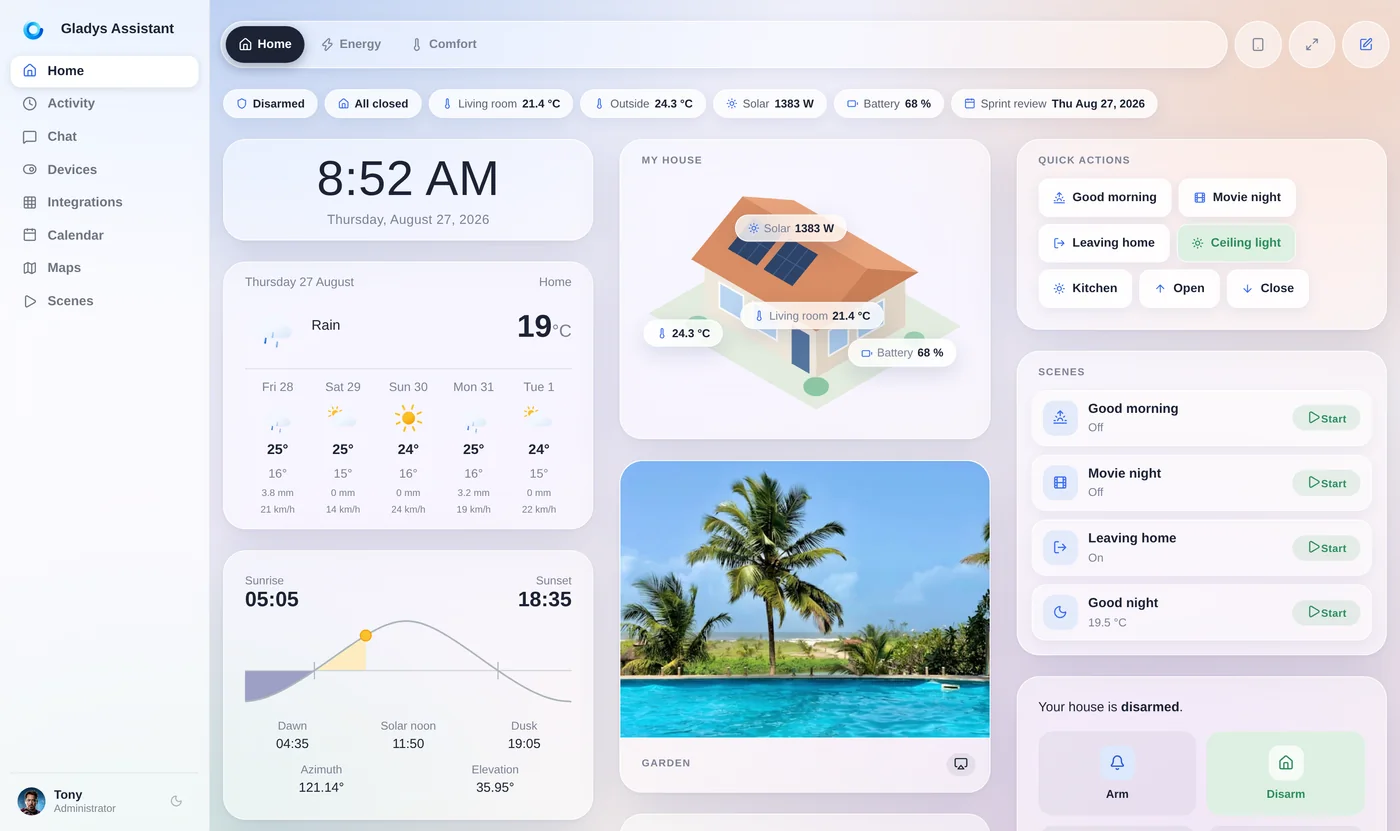
Gladys Assistant shares openHAB's values, open source, local and private, but makes the opposite trade-off on complexity. You add a device, it shows up with its features, you put it on a dashboard and use it in a visual scene. That's it.
Why people look for an alternative to openHAB
openHAB users who switch usually mention the same things:
- The Thing / Channel / Item model is powerful, but takes time to learn before your first device is useful.
- Configuration is split between the UI and text files, and many guides still assume text files.
- Rules can be written in DSL, Blockly, JavaScript, Python, Ruby or Groovy: flexible, but hard for the rest of the household to read.
- Building a family-friendly interface means designing pages or sitemaps yourself.
If you love tinkering, openHAB is great. If you want your home to just work, a simpler platform may suit you better.
Gladys Assistant vs openHAB
Two open-source, local platforms with different philosophies:
| Gladys Assistant | openHAB | |
|---|---|---|
| License | Apache 2.0 | EPL 2.0 |
| Stack | Node.js, Docker | Java 21, openHABian or Docker |
| Adding a device | Discover it, add it, done | Thing, then channels linked to items |
| Automations | Visual scenes | Rules DSL, Blockly, JavaScript, Python, Ruby, Groovy |
| Dashboards | Built in, mobile-first | Main UI pages or sitemaps to design |
| Integrations | Native integrations plus 90+ community integrations | 500+ add-ons |
| AI | AI assistant with Gladys Plus, built-in MCP server | LLM chat and built-in MCP server since 5.2 |
| Remote access | Optional Gladys Plus, encrypted | myopenHAB cloud connector |
openHAB wins on breadth of integrations and flexibility. Gladys wins on simplicity, time to first automation and everyday interface.
Why Gladys is a good openHAB alternative
What changes when you move to Gladys:
Install with one Docker command, add a device, see it on your dashboard.
Gladys installs and wires Zigbee2MQTT and its MQTT broker for you, no configuration files.
Triggers, conditions, if/then/else and delays in a visual editor, no scripting language to pick.
Gladys 5 was designed for phones and wall tablets out of the box.
Community integrations are Docker images, written in any language and installed in one click, sandboxed from the core.
Apache 2.0, developed in the open, with a friendly bilingual community.
How to move from openHAB to Gladys
A progressive migration:
- Install Gladys on the same machine or another one, and list your openHAB things by binding.
- Zigbee and Z-Wave: move your devices to Zigbee2MQTT and Z-Wave JS UI (if you already run Z-Wave JS UI with its MQTT gateway, Gladys can connect to it as is).
- Matter devices: share them with Gladys as a second controller.
- Brands (Hue, Sonos, Netatmo, Shelly, Tapo…): connect them through their Gladys integration.
- Rewrite your key rules as Gladys scenes, then switch off openHAB once everything runs in Gladys.
Check the Works with Gladys page first: openHAB covers more bindings, so make sure your devices are supported.
The same values, less configuration
openHAB and Gladys agree on the essentials: your home should run locally, on open-source software you control. Where they differ is who they're built for. openHAB gives power users every knob; Gladys gives households a smart home that's easy to set up and easy to live with.
Gladys is free. Gladys Plus is an optional subscription for encrypted remote access, backups, Alexa and Google Home, and the AI assistant.
Go further
Compare Gladys with other platforms:
An honest comparison with the most popular open-source platform.
The main open-source platforms, compared.
Local Zigbee with a managed setup and dashboards.
Connect Claude and other AI agents to your home.
Frequently asked questions
What is a simpler alternative to openHAB?
Gladys Assistant is a free, open-source and local platform designed to be simple: devices are discovered and added in a few clicks, dashboards are built in, and automations are visual scenes. Home Assistant is another option, more extensive but also more complex.
Is Gladys open source like openHAB?
Yes. Gladys Assistant is open source under the Apache 2.0 license and has been developed in the open since 2013. openHAB is open source under the Eclipse Public License 2.0.
Does Gladys have as many integrations as openHAB?
No. openHAB has more than 500 add-ons, while Gladys has its native integrations plus more than 90 community integrations. Gladys covers the major protocols (Zigbee, Z-Wave, Matter, MQTT) and popular brands, so check the Works with Gladys page for your devices.
Can Gladys run on the same Raspberry Pi as openHAB?
Gladys runs in Docker, so it can run next to openHAB during a migration if the machine has enough resources. A Raspberry Pi 4 or 5, or a mini-PC, is recommended. Only one of them can use a given USB Zigbee or Z-Wave dongle at a time.
Does openHAB have AI features?
Yes, openHAB 5.2 (July 2026) added an LLM chat interface and a built-in MCP server. Gladys also has a built-in MCP server, and its Gladys Plus subscription includes an AI assistant powered by open-weight models hosted in France.
Open source, local, and simple
Gladys is free and installs with a single Docker command. Try it next to openHAB and see the difference.