Open-source home automation
Run your smart home on free, self-hosted software you can read, trust and keep, instead of renting it from a closed cloud.
Most smart home products are closed boxes: proprietary software, a mandatory cloud, and a business that can change the rules, add a subscription or shut the service down whenever it wants. You don't own the system, you rent access to it.
Open-source home automation takes the opposite approach. The software that runs your home is free, public and self-hosted, so anyone can inspect it, improve it and keep it running for as long as they like. This guide explains what open-source home automation is, why it matters, the main platforms to know, and how to get started.
Why open source matters for your home
Your home automation runs your lights, locks, heating and alarm. That's not somewhere you want a black box you can't inspect or replace. Open source changes the balance of power:
- Transparency: the code is public, so anyone can verify what it does with your data, instead of trusting a marketing promise.
- Longevity: a community project can't be "sunset" by a single company. Even if the original team stops, the code stays and can be forked.
- No forced lock-in: open standards and an open codebase mean you're free to mix brands and move your setup, not trapped in one ecosystem.
- Privacy: most open-source platforms are self-hosted, so your habits, presence and camera feeds can stay on your own network.
- No surprise paywalls: the core software is free, so essential features can't suddenly move behind a new monthly subscription.
- Extensibility: a community builds integrations far faster than any single vendor, so more of your existing devices are supported.
Open source doesn't mean complicated or unsupported. The best projects are polished, actively maintained, and backed by large communities.
What is open-source home automation?
Open-source home automation means the software controlling your smart home is released under an open-source license, free to use, inspect and modify, and usually self-hosted on hardware you own. In practice:
- The source code is public and licensed openly (for example Gladys Assistant is Apache 2.0), so you, or anyone, can read and audit it.
- It's free to run: no per-device fee and no mandatory subscription to keep the core working.
- It's self-hosted on your own machine, so your automations and data stay under your control.
- It speaks open standards like Zigbee, Matter and MQTT instead of a single brand's proprietary protocol.
- A community contributes integrations, fixes and translations out in the open.
Open source and convenience aren't opposites: optional features like remote access or AI can still exist, they just become a choice rather than a requirement.
The best open-source home automation software compared
Several mature open-source platforms can run your smart home. Here is how the main ones compare, from the easiest to the most flexible:
| Platform | Interface & setup | Ease of use | License | Best for |
|---|---|---|---|---|
| Gladys Assistant | Clean UI, no config files | Very easy | Apache 2.0 | Open source without the learning curve |
| Home Assistant | UI, YAML for advanced setups | Moderate to advanced | Apache 2.0 | The largest integration catalog |
| openHAB | Text config and UI | Advanced | EPL 2.0 | Vendor-neutral, powerful rules |
| Jeedom | UI with plugin marketplace | Moderate | GPL (core) | Local boxes and a plugin ecosystem |
| Domoticz | Lightweight, utilitarian UI | Moderate | GPLv3 | Very low-power hardware |
| Node-RED | Visual flow editor | Moderate | Apache 2.0 | Building advanced automation logic |
A self-hosted platform (Apache 2.0) focused on simplicity: a clean interface, no configuration files, scenes built by clicking, and a one-command Docker install. Its external integrations let anyone publish an integration on GitHub, installable in one click and sandboxed. Great if you want open source without the steep learning curve.
The most feature-rich and popular open-source platform, with a huge integration catalog. Extremely powerful, but configuration can get deep and YAML-heavy for advanced setups.
A mature, Java-based platform known for flexibility and vendor neutrality. Powerful rules engine, with a steeper, more technical setup.
A French open-source platform with a plugin marketplace (some paid). Popular on local boxes, with a more technical, plugin-driven approach.
A lightweight, long-running open-source system that runs well on very low-power hardware, with a more utilitarian interface.
Not a full platform but an open-source flow-based automation tool, often paired with the others to build advanced logic visually.
Do you need a special hub or hardware?
One of the big advantages of open-source home automation is that you are not tied to a proprietary hub. The software runs on hardware you already own or can buy cheaply:
- A small computer to host it: a Raspberry Pi, a mini-PC or a NAS is enough to run the platform 24/7 on your own network.
- USB radio dongles for wireless devices: add a Zigbee or Z-Wave USB stick to talk to hundreds of sensors and switches locally, with no vendor bridge required.
- Matter and Thread for newer gear: Matter devices on Wi-Fi or Ethernet join your network directly, while Thread devices need a Thread Border Router to reach it. That border router can be a device you already own (some speakers, TV boxes and hubs act as one) or an open-source setup on your own host with an 802.15.4 radio, so it still doesn't lock you into a brand.
- Your existing Wi-Fi and IP devices: many cameras, plugs and TVs connect directly over your local network.
So there is no mandatory, proprietary box to buy: a cheap mini-computer plus a USB radio dongle is all most setups need.
Gladys Assistant: open source, made simple
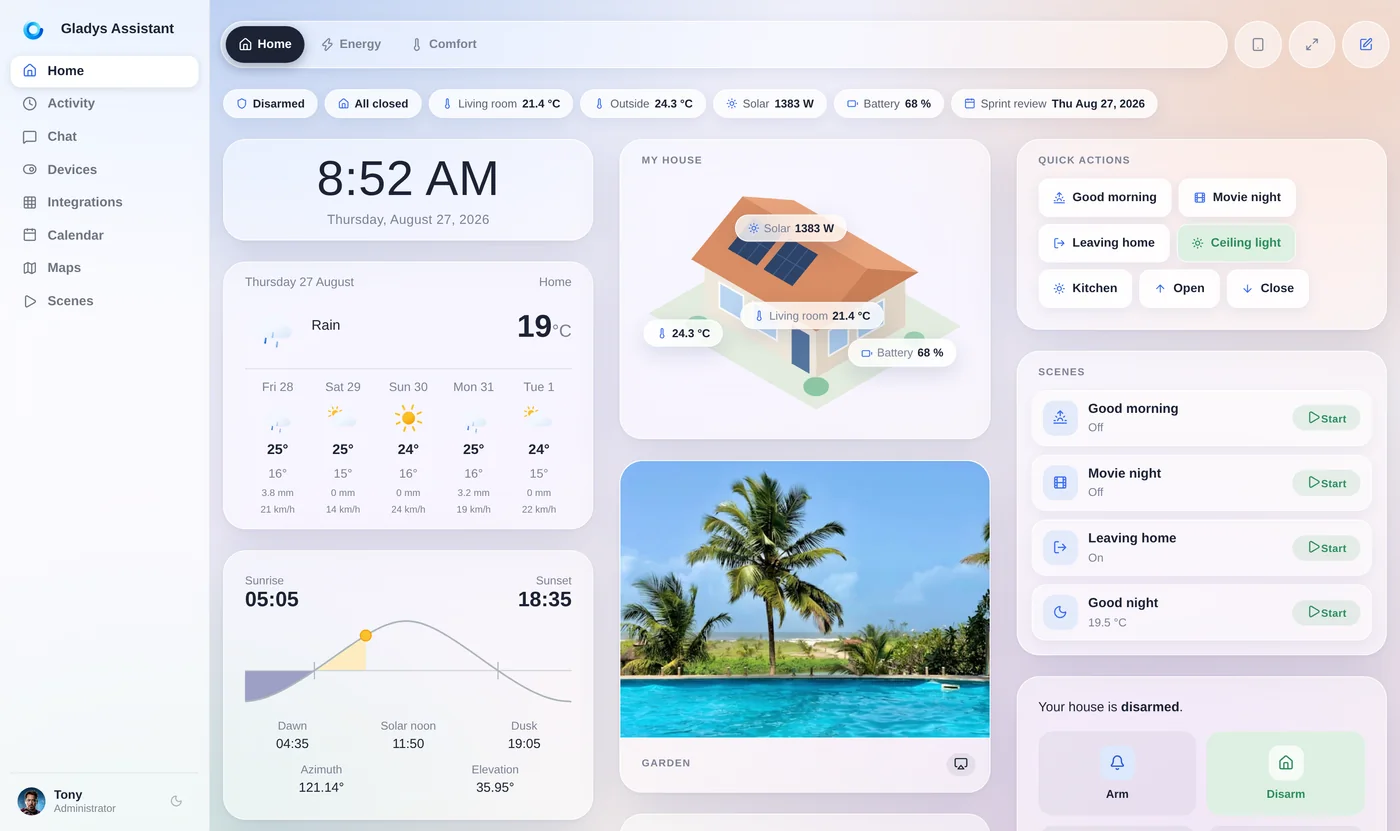
Gladys Assistant is a free, open-source (Apache 2.0), self-hosted home automation platform. The full source code is on GitHub, it installs in a single Docker command on a Raspberry Pi, mini-PC or NAS, and it runs entirely on your local network.
Where it stands out is simplicity. Everything is configured from a clean interface, with no configuration files and no YAML, and scenes are built by clicking. It's based on open standards (Zigbee, Matter, MQTT) with a full local automation engine, so your everyday scenes run at home. Optional features like voice, AI and remote access rely on a private, secure cloud from the same independent project: no ads, no data resale, and end-to-end encrypted remote access.
Go deeper
Whether you're comparing platforms or moving off a closed ecosystem, these guides help you choose and make the switch:
A simpler, local, open-source platform, without the YAML and the steep learning curve.
How the two main open-source, local-first platforms really compare.
An open-source alternative to Jeedom, without a paid plugin marketplace.
Why local-first matters and how to build a home that runs without the cloud.
Keep the convenience of AI and voice control, on a private cloud, not a big-tech assistant.
Frequently asked questions
What is open-source home automation?
Open-source home automation means the software that controls your smart home is released under an open-source license, free to use, inspect and modify, and usually self-hosted on hardware you own. The code is public, there's no mandatory subscription for the core, and it typically uses open standards like Zigbee, Matter and MQTT.
What is the best open-source home automation software?
The main open-source platforms are Gladys Assistant, Home Assistant, openHAB, Jeedom and Domoticz. Home Assistant has the largest integration catalog, while Gladys Assistant focuses on simplicity with a clean interface, no configuration files and a one-command install, plus external integrations that anyone can publish and that install in one click. The best choice depends on whether you prioritize raw flexibility or ease of use.
Do you need a hub for open-source home automation?
No proprietary hub is required. An open-source platform runs on a small computer you own, such as a Raspberry Pi, a mini-PC or a NAS. To control wireless devices you simply add a USB radio dongle (Zigbee or Z-Wave). Newer gear connects through the open Matter and Thread standards: Matter devices on Wi-Fi or Ethernet join your network directly, while Thread devices also need a Thread Border Router, which can be a device you already own or an open-source setup on your own host with an 802.15.4 radio. Either way, there is no brand-specific box to buy.
Is open-source home automation free?
Yes, the core software is free. Platforms like Gladys Assistant (Apache 2.0) and Home Assistant cost nothing to download and run on your own hardware. Some projects offer optional paid services (such as remote access or AI), but you're never forced into a subscription to keep your home automation working.
Is open-source home automation private and secure?
It can be more private than closed cloud products. Because most open-source platforms are self-hosted, your automations and data stay on your own network instead of a manufacturer's servers, and because the code is public, anyone can audit what it does. Security still depends on keeping your system updated, as with any software.
Do I need to be a developer to use open-source home automation?
No. While some platforms are quite technical, Gladys Assistant is designed for non-developers: it installs in a single Docker command, everything is configured by clicking in the interface with no configuration files.
What license is Gladys Assistant released under?
Gladys Assistant is released under the Apache 2.0 license, a permissive open-source license. The full source code is available publicly on GitHub, so anyone can read, audit, contribute to or fork it.
Start with open-source home automation
Gladys is free, open-source (Apache 2.0), and installs in a single Docker command. Self-hosted, local-first, no cloud required.