Looking for a Jeedom alternative?
Meet Gladys Assistant, the French, privacy-first, open-source home automation platform with a modern interface and free integrations.
Jeedom is a solid, mature project, but it isn't for everyone. Between paid plugins, an interface that feels dated, and manual updates, many people look for something simpler and more predictable, without giving up open-source and local control.
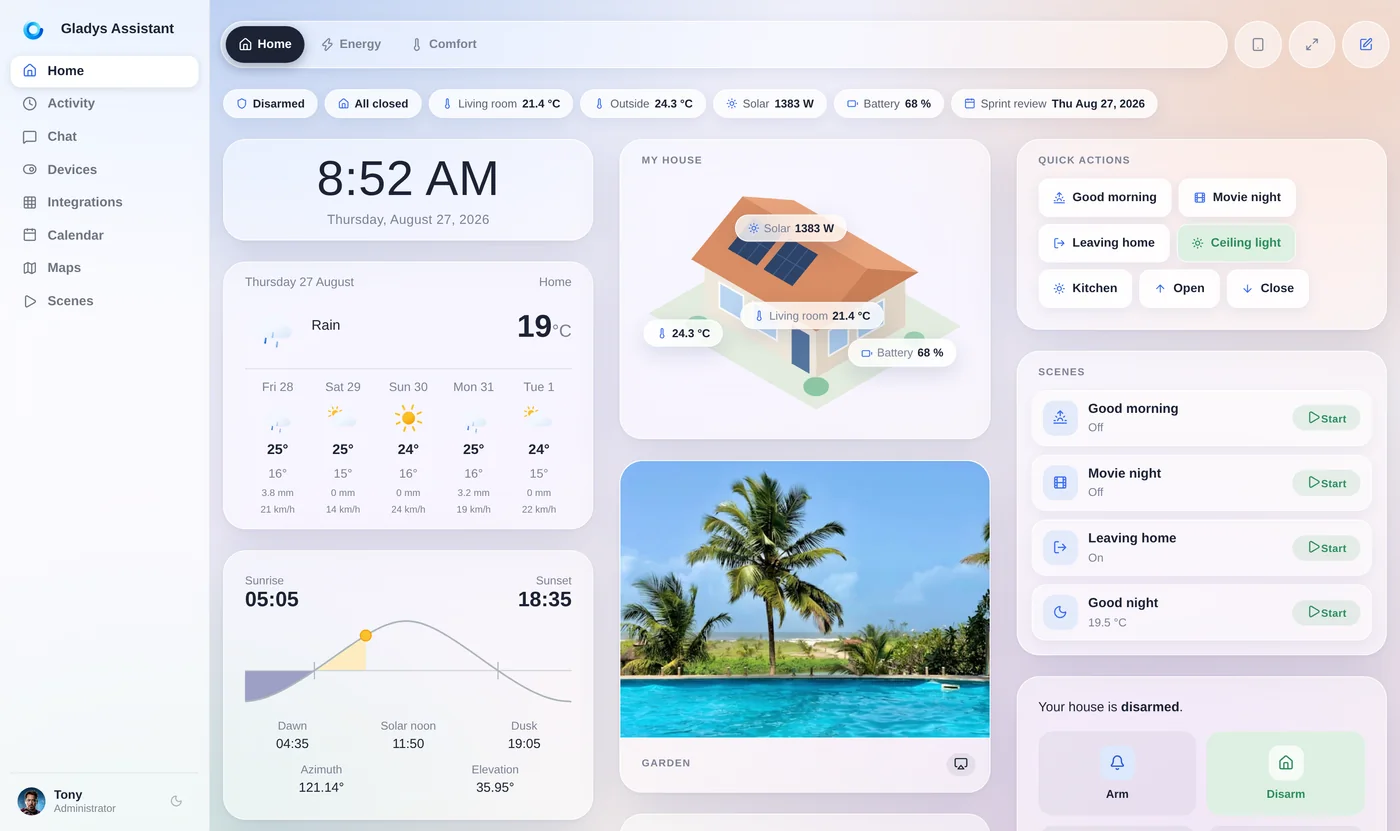
That's exactly what Gladys Assistant offers. Like Jeedom, it's a French, free, open-source, self-hosted home automation platform, but built around one idea: think about the user first. A clean modern interface, no configuration files, no cloud required, and every integration free and open.
Why look for an alternative to Jeedom?
Jeedom is powerful and flexible, but that comes with trade-offs. The most common reasons people start searching for an alternative:
- Many of the best plugins are paid, so the real cost of a setup is hard to predict.
- The interface feels dated and exposes a lot of technical options at once.
- Core and plugins are updated manually, which can break a working setup.
- Building scenarios can feel more technical than it needs to be.
- You want a clean, stable experience that just works, without tinkering.
None of this makes Jeedom a bad project, it's excellent if you love its plugin ecosystem and flexibility. It's simply a question of fit, and for many people who just want a smart home that works, there's a simpler way.
Why Gladys is a great Jeedom alternative
Every Gladys integration is free and open-source, the native ones and the community ones alike. Nothing sits behind a paywall.
Anyone can publish a Gladys integration on GitHub, for free, with no pull request and no review. You install it in one click from the catalog inside Gladys, and it runs in an isolated sandbox so it can never break your instance.
Everything is configured by clicking, in an interface designed like a consumer product, not a technical control panel.
Updates are fully automatic and atomic: Gladys can never end up in a half-broken state between two versions.
Like Jeedom, Gladys runs at home, on your machine. Your data stays on your local network, with no mandatory cloud and no data selling.
Zigbee, Matter and MQTT are first-class citizens, so thousands of devices are supported through these open protocols.
Gladys is a French project too: ask a question and the founder answers personally. Your feedback genuinely shapes the roadmap.
Being fair: where Jeedom has the edge
I'm the creator of Gladys, so let me be transparent. Jeedom has a larger catalog through its plugin marketplace, with particularly deep Z-Wave support, so if you rely heavily on Z-Wave or own very niche devices, Jeedom may cover them when Gladys doesn't yet. Its scenario engine is also extremely flexible for power users, and its all-in-one boxes are a convenient plug-and-play option.
But Gladys already supports thousands of devices through Zigbee and Matter, the open standards the whole industry is moving toward, and every integration is free. The catalog also grows from outside the core now: with external integrations, anyone can publish an integration on GitHub, with no review and no fee, and you install it in one click from Gladys, sandboxed so it can't destabilize your instance. And if the one you need doesn't exist yet, you can build it from the official template rather than wait for it. You can also run Gladys and Jeedom side by side, using one as a backend and the other as your interface. In other words, choosing Gladys rarely means giving anything up.
Other open-source Jeedom alternatives
Gladys isn't the only option. To be fair, here are the main open-source alternatives to Jeedom:
The most popular open-source platform, with a huge catalog. Extremely powerful, but with a steep learning curve and some YAML.
Java-based, very powerful and rules-driven. Highly flexible, but with a learning curve comparable to Home Assistant.
Lightweight and runs on modest hardware. Mature and stable, but the interface feels dated.
A polished experience, but it relies on proprietary paid hardware rather than being fully open and self-hosted.
Among these, Gladys stands out for its simplicity, its modern product experience, and the fact that every integration is free, with no plugin paywall.
Frequently asked questions
What is the best alternative to Jeedom?
It depends on your profile. If you want a French open-source platform with a modern interface and free integrations, Gladys Assistant is a great choice. Other open-source alternatives include Home Assistant, openHAB and Domoticz, each with its own trade-offs.
Is there a Jeedom alternative without paid plugins?
Yes. Gladys Assistant has no paywall on integrations: every one is free and open-source, including the community external integrations you install from its store in one click. The only optional cost is the Gladys Plus subscription for remote access, AI and backups.
Can I create a Gladys integration myself, like a Jeedom plugin?
Yes, and it's deliberately as open as possible. You clone the official template, adapt it to your device, publish it on a public GitHub repository, and it is listed within the hour in the catalog of every Gladys instance. No pull request, no review, no approval and no fee. Each external integration runs in an isolated sandbox, so publishing freely never comes at the expense of other people's stability.
Is there a simpler Jeedom alternative for beginners?
Gladys Assistant is designed for simplicity: a clean modern interface, no configuration files, automatic atomic updates, rich documentation with videos. It's one of the easiest open-source options to get started with.
Can I migrate from Jeedom to Gladys?
You don't have to migrate everything at once. Using Zigbee2MQTT or Matter, the same devices can appear in both at the same time, so you can run them side by side and switch over gradually. They can also talk over MQTT or HTTP.
Is Gladys also a French open-source project like Jeedom?
Yes. Like Jeedom, Gladys Assistant is a French, open-source, self-hosted project with an active French-speaking community and support in French. The main difference is Gladys' focus on a polished interface and free, open-standard integrations.
Is Gladys a good Jeedom alternative for privacy?
Yes. Like Jeedom, Gladys is self-hosted and runs on your own machine, so your smart home data stays on your local network. There is no mandatory cloud, no tracking and no data selling.
Try the simple Jeedom alternative
Gladys is free, open-source, and installs in a single Docker command. Privacy-first, self-hosted, no cloud required, and every integration is free.