Looking for a Hubitat alternative?
Keep what you like about Hubitat, local automations and no cloud dependency, and add a modern interface, open source and your own choice of hardware.
Hubitat Elevation earned its place in North American smart homes by doing one thing right: automations run on the hub, in your home, not in someone's cloud. Many SmartThings and Wink refugees landed there for exactly that reason.
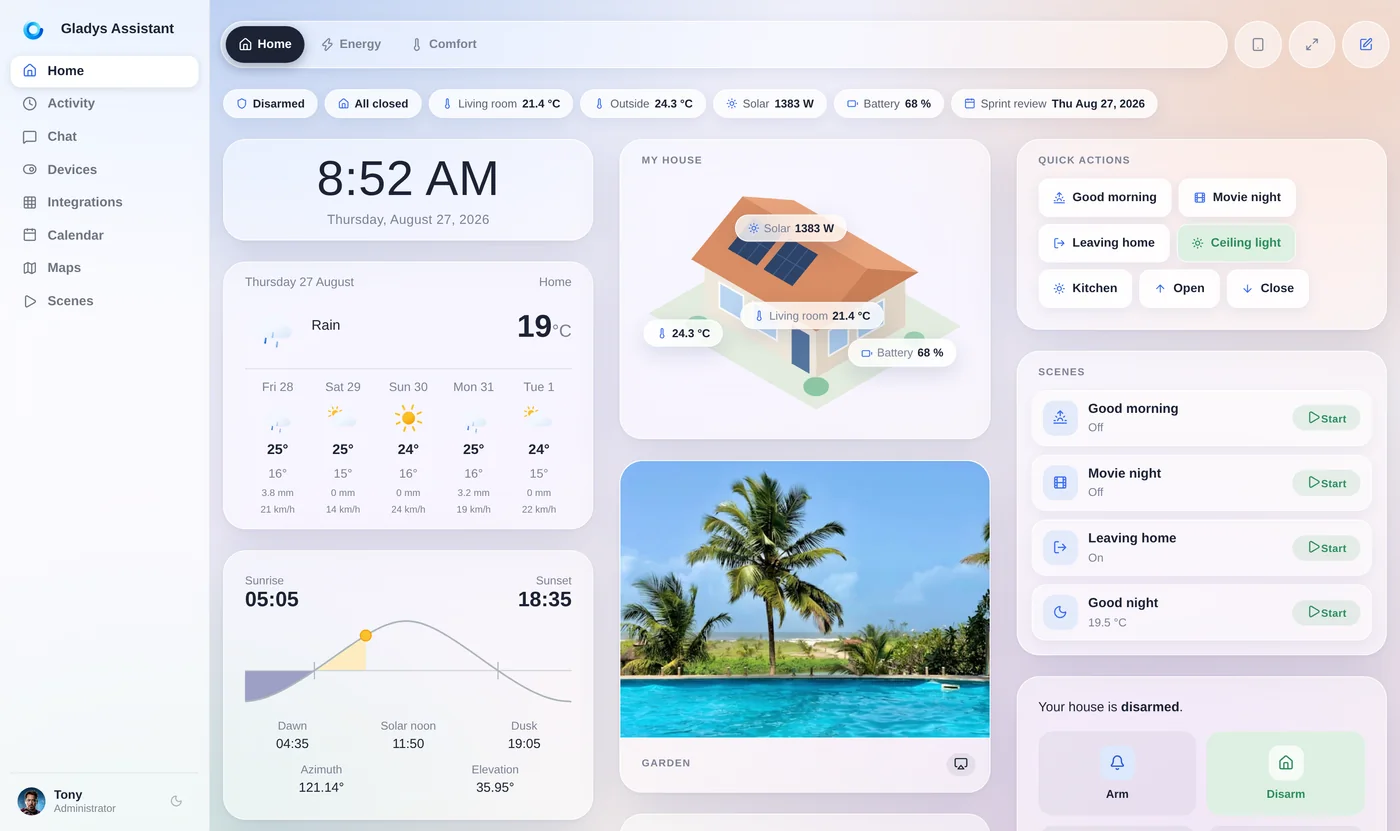
Gladys Assistant shares that philosophy, and goes one step further. It's a free, open-source smart home platform that you run on your own mini-PC or Raspberry Pi. Your Zigbee, Z-Wave and Matter devices pair directly with it, your scenes run locally, and the interface was designed from the ground up for the phone in your pocket.
Why people look for an alternative to Hubitat
Hubitat is a solid local hub, but some trade-offs come up again and again:
- The interface feels dated, and customizing dashboards often means writing CSS.
- Rule Machine is powerful, but many users find it hard to read and maintain.
- The platform is proprietary: the built-in drivers are closed, and custom apps and drivers are written in Groovy.
- Remote Admin and Hub Protect are paid yearly services ($45/year each since May 2025).
- You're tied to Hubitat's hardware: when a radio or a model is discontinued, your options narrow.
None of this makes Hubitat a bad choice. But if you want local control with a modern interface and open source, there is another way.
Gladys Assistant vs Hubitat Elevation
How the two compare on what matters for a local smart home:
| Gladys Assistant | Hubitat Elevation | |
|---|---|---|
| Hardware | Your own mini-PC, Raspberry Pi or NAS | Hubitat's C-8 Pro hub ($184.95) |
| Automations run locally | Yes | Yes |
| Zigbee and Z-Wave | Yes, with USB dongles (Zigbee2MQTT, Z-Wave JS UI) | Yes, built-in radios, Z-Wave Long Range |
| Matter | Yes, Gladys is a Matter controller | Yes |
| Automations | Visual scenes, no code | Rule Machine, Basic Rules, Groovy apps |
| Source code | Open source (Apache 2.0) | Proprietary |
| Remote access | Optional Gladys Plus ($7.99/month, also includes AI, backups, Alexa and Google) | Remote Admin ($45/year), Easy Dashboard cloud links for free |
| Built-in AI assistant | Yes, with Gladys Plus, plus a free MCP server for Claude and others | No |
Hubitat wins on plug-and-play hardware with built-in radios. Gladys wins on interface, openness and freedom of hardware.
Why Gladys is a good Hubitat alternative
What you get when you move your home to Gladys:
Gladys runs on your own machine. Your devices, scenes and history stay on your network and keep working without the internet.
Zigbee through Zigbee2MQTT, Z-Wave through Z-Wave JS UI (US 908 MHz sticks), and Matter, side by side.
Gladys 5 was designed for phones and wall tablets: dashboards that look good without a line of CSS.
Triggers, conditions, if/then/else and delays in a visual editor that the rest of the household can understand.
Talk to your home in plain language with Gladys Plus, or connect Claude through the built-in MCP server.
Apache 2.0, developed in the open since 2013. Your hardware, your data, your choice.
How to migrate from Hubitat to Gladys
You can move room by room, keeping Hubitat running in the meantime:
- Install Gladys on a mini-PC or a Raspberry Pi, and list your Hubitat devices by protocol.
- Zigbee devices: add a Zigbee USB dongle, remove each device from Hubitat, and pair it with Zigbee2MQTT in Gladys.
- Z-Wave devices: add a US 908 MHz Z-Wave stick, exclude each device from Hubitat, and include it in Z-Wave JS UI.
- Matter devices: share them with Gladys as a second controller (Matter supports several), then remove them from Hubitat.
- Wi-Fi and cloud devices (Hue, Kasa, Tapo, Shelly, Sonos…): connect them through their Gladys integration.
- Rebuild your rules as Gladys scenes, then retire the hub when you're ready.
Tip: start with the devices in one room to get familiar with Gladys before moving the rest.
Hubitat's philosophy, without the closed box
If you chose Hubitat to get away from the cloud, you already understand why local matters. Gladys keeps that promise and removes the other constraints: open source code, standard hardware you can upgrade, and an interface you'll actually enjoy using.
Gladys is free. Gladys Plus is an optional subscription for encrypted remote access, backups, Alexa and Google Home, and the AI assistant, with a one-month free trial.
Go further
More guides for a local smart home:
Hubitat, Homey, SmartThings and a mini-PC, compared.
A local, private alternative to Samsung SmartThings.
Run your Z-Wave network locally with a simple interface.
Local Zigbee with a managed setup and dashboards.
Building your own local hub with a mini-PC.
Frequently asked questions
What is the best Hubitat alternative?
If you want to stay local, the main options are Home Assistant, Gladys Assistant and openHAB, all open source and self-hosted. Gladys is the simplest of the three: a modern interface, visual scenes and a managed Zigbee2MQTT setup, running on a mini-PC or a Raspberry Pi.
Can I move my Zigbee and Z-Wave devices from Hubitat to Gladys?
Yes. Zigbee and Z-Wave are standard protocols: remove or exclude each device from Hubitat, then pair it with Zigbee2MQTT or include it in Z-Wave JS UI with a USB dongle. Matter devices can be shared with Gladys as a second controller.
Does Gladys need a subscription like Hubitat's Remote Admin?
No. Gladys is free and works fully on your local network. Gladys Plus is optional ($7.99/month in the US and Canada, with a one-month free trial) and bundles encrypted remote access, backups, Alexa and Google Home, and the AI assistant.
Is Hubitat open source?
No. The Hubitat platform and its built-in drivers are proprietary; Hubitat publishes some example apps and drivers, and the community writes custom ones in Groovy. Gladys Assistant is fully open source under Apache 2.0.
Which hardware do I need to replace a Hubitat hub?
A mini-PC or a Raspberry Pi running Docker, plus a Zigbee USB dongle and a US 908 MHz Z-Wave stick if you use those protocols. Matter and Wi-Fi devices don't need any extra radio.
A local smart home, open source
Gladys is free, open source and installs with a single Docker command. Try it next to your Hubitat and move at your own pace.