An alternative to the Home Assistant Green and Yellow
Want a small, always-on box to run your smart home? A mini-PC or a Raspberry Pi running Gladys Assistant gives you more power and a simpler interface, for a similar budget.
The Home Assistant Green is a neat plug-and-play box, and the Yellow, its Raspberry Pi based sibling, stopped production in October 2025. If you're shopping for one of them, you're really looking for two things: a small computer that runs 24/7, and smart home software that's pleasant to live with.
You don't need a dedicated box for that. A compact mini-PC, like the ones built around Intel's N100 and N150 chips, or a Raspberry Pi 5, runs Gladys Assistant perfectly. Gladys is free, open-source, runs everything locally, and is designed to be set up without YAML or configuration files.
What to know before buying a Home Assistant Green
The Green is a good product for what it is, but its fixed hardware has limits worth knowing:
- It comes with 4 GB of RAM and 32 GB of eMMC storage that you can't upgrade: history, camera snapshots and add-ons all share that space.
- It has no built-in Zigbee, Thread or Z-Wave radio: you add a USB dongle anyway, just as you would with any other computer.
- It runs Home Assistant only, with its learning curve: integrations, YAML for advanced setups, and frequent breaking changes to follow.
- The Yellow, the other official box, has been discontinued, which is a reminder that dedicated hardware comes and goes.
A general-purpose mini-PC avoids most of these limits, and you choose the software that runs on it.
Gladys on a mini-PC vs a Home Assistant Green
A typical Intel N100/N150 mini-PC running Gladys, compared to the Green:
| Mini-PC + Gladys Assistant | Home Assistant Green | |
|---|---|---|
| Processor | Intel N100/N150 class x86 CPU | Rockchip RK3566 (ARM) |
| Memory | Usually 8 to 16 GB | 4 GB |
| Storage | SSD, usually 256 GB to 1 TB, replaceable | 32 GB eMMC, not upgradable |
| Zigbee / Thread / Z-Wave radio | Add a USB dongle | Add a USB dongle |
| Software | Gladys Assistant, free and open-source, no YAML | Home Assistant OS |
| Can run other services | Yes: Docker, Plex, backups, a local AI model… | Only as Home Assistant add-ons |
The Green's advantage is that it's ready out of the box. A mini-PC asks for a little setup (installing Linux, then Gladys), and our step-by-step guide walks you through it.
Why run Gladys on your own box
What you get with a mini-PC or a Raspberry Pi running Gladys:
More memory and storage than any fixed smart home box, for years of history, camera snapshots and new features.
Everything is configured from the interface: devices, dashboards and scenes, no configuration files to edit.
Plug in a Zigbee or Z-Wave USB dongle, or use Matter, and pair your devices directly, locally.
Everything runs on your machine and keeps working when the internet goes down. Your data stays at home.
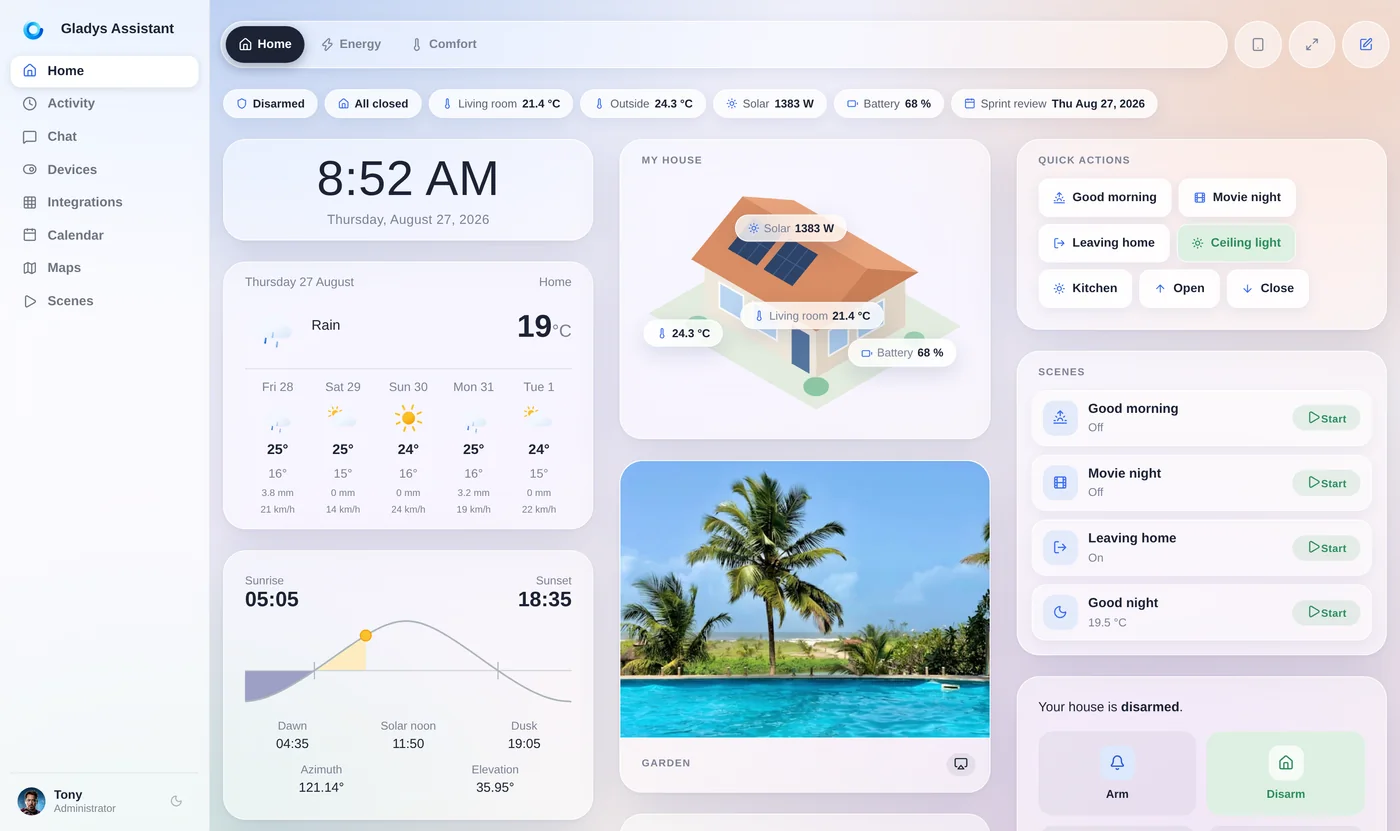
Gladys 5 has a modern interface designed for the phone in your pocket and the tablet on your wall.
No license, no mandatory subscription. Optional Gladys Plus adds encrypted remote access, backups and AI.
What to buy instead
Three good options, depending on your budget and what you already own:
- A mini-PC (recommended): an Intel N100 or N150 model, like the Beelink Mini S13 I recommend, is fast, silent, sips power and costs about the same as a dedicated smart home box.
- A Raspberry Pi 5: the Gladys image is available directly in Raspberry Pi Imager. Boot from an SSD rather than a microSD card for reliability.
- A machine you already own: Gladys runs anywhere Docker runs, so a Synology NAS, an Unraid server or an old laptop works too.
- Add a Zigbee USB dongle (and a Z-Wave stick if you need one), then follow the installation guide.
Already running Home Assistant on a Green? You can install Gladys on another machine and try it side by side before deciding.
A smart home box that's really yours
A dedicated box is convenient until its hardware is discontinued or runs out of room. A standard mini-PC is easy to replace, easy to upgrade, and can run other services next to your smart home.
Gladys has been developed in the open since 2013. It's free and open-source, focused on simplicity, and runs everything locally, on the hardware of your choice.
Go further
Pick your hardware and get started:
Which mini-PC to buy, and what you actually need.
Every hub compared: price, protocols, local control.
The recommended setup, step by step.
Why people switch from Home Assistant to Gladys.
The Zigbee coordinator to plug into your new box.
The brands and protocols supported by Gladys.
Frequently asked questions
What is a good alternative to the Home Assistant Green?
A small Intel N100 or N150 mini-PC running Gladys Assistant. For a similar budget you usually get 8 to 16 GB of RAM and a replaceable SSD, versus 4 GB of RAM and 32 GB of eMMC on the Green. A Raspberry Pi 5 with the Gladys image is another option.
Is the Home Assistant Yellow discontinued?
Yes. Nabu Casa ended production of the Home Assistant Yellow in October 2025, citing the availability and price of the Raspberry Pi Compute Module 4 it is built on. Units already sold keep working, and the Green remains the official plug-and-play box.
Can I use a mini-PC instead of a Home Assistant box?
Yes. Any small x86 computer that stays on 24/7 works well, and it can run Gladys Assistant or Home Assistant. A mini-PC is usually more powerful and more upgradable than a dedicated box, and it can run other services next to your smart home.
Do I need a Zigbee dongle with Gladys?
Only for Zigbee devices, just like with the Home Assistant Green, which has no built-in radio either. Plug a Zigbee USB dongle into your mini-PC or Raspberry Pi and pair your devices with Zigbee2MQTT. Matter over Wi-Fi devices need no dongle.
Is Gladys easier than Home Assistant?
Gladys is designed to be simpler: everything is configured from the interface, with no YAML, and it focuses on the features most homes actually use. Home Assistant supports more integrations and is more customizable, at the cost of a steeper learning curve.
Is Gladys free?
Yes. Gladys is free and open-source, forever. An optional Gladys Plus subscription adds encrypted remote access, Alexa and Google Home, backups and AI, starting at $7.99/month in the US and Canada, with a 1-month free trial.
Build your own smart home box
Gladys is free, open-source and installs in a single Docker command, on a mini-PC, a Raspberry Pi or the machine you already own.