Integración domótica Moon phase, gratuita y de código abierto
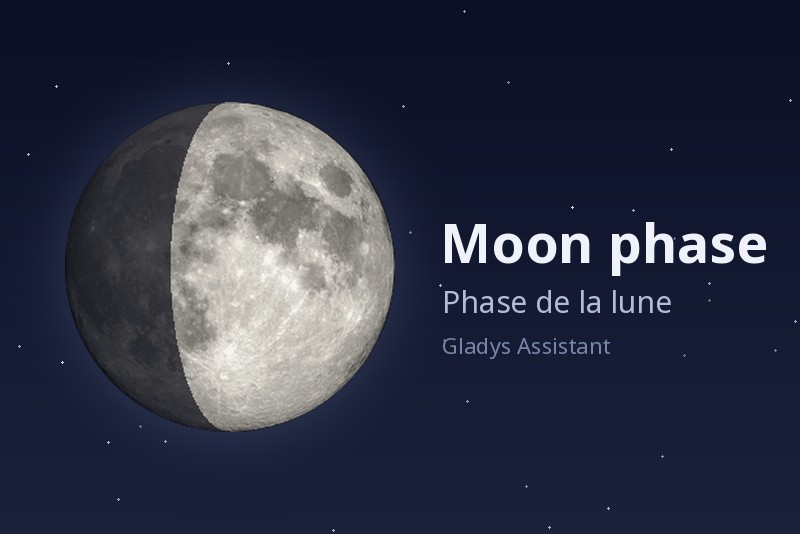
Moon phase widget: illumination, moonrise and moonset, upcoming lunar events.
Publicado por William-De71
- Dispositivos
- Versión 1.0.0
- Requiere Gladys >=5.1.1
- ★ 0
La documentación de esta integración la escribe su autor y, por ahora, solo está disponible en inglés.
This integration adds a "Moon phase" dashboard widget to Gladys: today's phase, the illumination and age of the moon, its lit disk, moonrise and moonset, and the upcoming lunar events.
Ready to use
Nothing to configure: everything is computed locally from the location of your house, with no account, no key and no internet access.
The house must have a location: set it in Settings → Houses.
Add the widget
Edit a dashboard, pick Moon phase among the integration widgets, then set:
| Setting | What it does |
|---|---|
| House | Name of the house whose location is used. Leave empty for the first house with a location (the single-house case). |
| Display details | Shows the list under the moon (distance, trajectory, constellation, upcoming events). Uncheck to keep only the phase, the disk, moonrise and moonset. |
| Compute the values at midnight | Computes the illumination, distance, age and countdowns at midnight, like lunar calendars, so both can be compared line by line. Moonrise and moonset do not change. |
What the widget shows
- The phase (New Moon, Waxing Crescent, First Quarter, Waxing Gibbous, Full Moon…), the illuminated percentage and the age of the moon (days since the last new moon).
- The moon disk (a NASA photo) with its lit part.
- Moonrise and moonset of the day, in the timezone of Gladys.
--:--when the moon does not rise or set that day (about one day a month). - Today: Earth-Moon distance, trajectory (ascending or descending), constellation (sidereal zodiac, like lunar calendars) and the next node.
- Upcoming: full moon, new moon, perigee, apogee and next lunar eclipse, with the number of days and the date.
The widget refreshes every 10 minutes and right after midnight.
FAQ
The widget says no house has a location. Set the location of a house in Settings → Houses.
The widget says "No house named …". The name typed in the House setting matches no house: the message lists the names to use.
The times are off. Check the timezone of Gladys (Settings → System); the integration uses it. Restart the integration after changing it.
My language is not English, French or German. The widget is then shown in English.
Parámetros de configuración
Estos son los parámetros que Moon phase te pide en su pantalla de configuración en Gladys.
| Parámetro | Tipo | Obligatorio | Descripción |
|---|---|---|---|
| Ready to use | section | No | Nothing to configure: everything is computed locally from the location of your house, with no account and no internet access. Add the "Moon phase" widget to a dashboard. The house must have a location (Settings → Houses). |
Cómo instalar Moon phase en Gladys
- En Gladys, abre Integraciones: Moon phase aparece en el catálogo junto a las integraciones nativas, con una insignia de comunidad.
- Haz clic en Instalar. Gladys descarga la imagen Docker (
ghcr.io/william-de71/gladys-moon-phase:1.0.0), la ejecuta en un entorno aislado del núcleo y genera la interfaz de la integración (dispositivos, descubrimiento y configuración). - Abre la pantalla de Configuración de la integración, rellena los parámetros y guarda.
- También puedes instalarla directamente desde la URL de su repositorio: https://github.com/William-De71/gladys-moon-phase.
Moon phase requiere Gladys >=5.1.1. El catálogo de Gladys se actualiza cada hora, así que una nueva versión está disponible como máximo una hora después de publicarse.
¿Todavía no usas Gladys? Es gratuito y de código abierto: sigue la guía de instalación para empezar.
Sobre las integraciones externas
Moon phase es una integración externa: una integración comunitaria empaquetada como contenedor Docker y publicada en GitHub. Gladys la instala con un clic y la ejecuta en un entorno aislado del núcleo. La publica y mantiene William-De71, no el equipo principal de Gladys.
- Explorar todas las integraciones externas
- Descubrir las integraciones nativas incluidas en Gladys
- Crear y publicar tu propia integración externa
- Código fuente en GitHub — fuente de esta documentación