Integración domótica IPX800 V3, gratuita y de código abierto
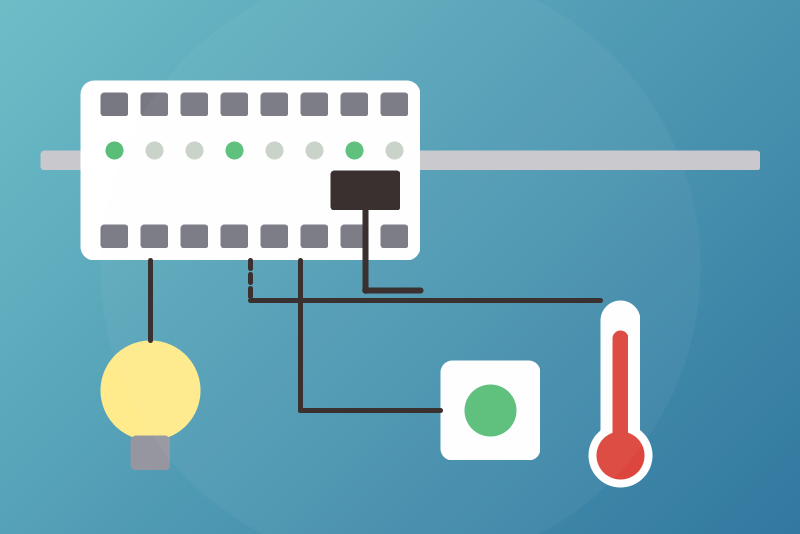
GCE IPX800 V3 on your network: relays, digital inputs, analog temperature and humidity sensors.
Publicado por LM1LC3N7
- Dispositivos
- Versión 0.1.1
- Requiere Gladys >=5.1.0
- ★ 0
La documentación de esta integración la escribe su autor y, por ahora, solo está disponible en inglés.
Brings up to three GCE Electronics IPX800 V3 into Gladys through their local HTTP interface: their relays, their inputs and their analog inputs wired to a temperature or humidity probe.
Never tested with a real device: written from the open-source Home Assistant integration ha_ipx800v3 and the test tools cce66 published on the forum. Tell us what you see on yours. Not affiliated with GCE Electronics.
For an IPX800 V4 or V5, use the IPX800 integration (another API).
Installation
- In Gladys, Integrations > IPX800 V3: enter the address of the IPX800
(e.g.
192.168.1.50, with:portonly if its web server is not on 80; give it a fixed address in your router). - If the IPX800 protects its pages with a user and a password (Network > Security), enter both; leave them empty otherwise.
- On the same page, list in "Relays Gladys may drive" the relays Gladys
must drive, and those only (e.g.
R1, R2; see "Relays" below: never a pump, a ventilation, a door strike…). If the IPX800 has extensions (X-880, X-24D), list them in "Extensions", e.g.R9-R16, D9-D24. Then save. - "Test the connection" reads the IPX800 at once (once an interval has passed since the last read) and shows what it found.
- In Discover, create the devices you want. A listed relay comes as a switch (or a light); the others come read only ("State (read only)"): Gladys shows their state, nothing can switch them.
A relay listed after its creation stays read only until you click "Update" on it in Discover: it then gets its switch (or light), next to its "State (read only)", which stays. The status of the integration says how many relays are read only while none is listed, and which listed relays still wait for "Update".
The password goes with every request, over plain http (as the IPX800's own pages do): anyone who can watch your local network can read it. It is kept by Gladys in its database, never shown again, sent only to the IPX800, and never written in the logs nor in the files of the integration.
What you get
| On the IPX800 | In Gladys | Code (in the name) |
|---|---|---|
| Relay 1 to 8 (up to 32) | read only, or a switch / light if you list it | R3 |
| Input 1 to 8 (up to 32) | a binary input (read only) | D3 |
| Analog input 1 to 4, TC4012, TC100 or SHT temperature probe | temperature (°C) | A1 |
| Analog input 1 to 4, SHT humidity probe | humidity (%) | A2 |
The IPX800 V3 answers 32 relays and 32 inputs, wired or not: the
integration shows its 8 relays and 8 inputs, and what you list in
"Extensions". An input is "on" when the IPX800 reads it closed (dn).
An analog input is published only when the probe type chosen on the IPX800 is one of those in the table; its value is computed with the GCE formulas (those of the Home Assistant integration). The humidity of an SHT probe is corrected for 15 °C (the integration does not know what temperature the probe sees): at 25 °C it reads about 2 % too high. The other types (raw, voltage, light, X-400 CT, pH, ORP) are not in this version: the status names the inputs concerned. A raw value of 0 (nothing wired) or 1023 (open input) is no measurement.
The IPX800 is read every 10 seconds by default (5 s at least), through its
page globalstatus.xml, or status.xml when that one is missing. A value
the IPX800 does not give (missing, a text, out of range) is not published:
never as 0.
Several IPX800 V3
Keep the first one in the fields at the top, and put the other one in
"IPX800 #2" (address with :port if needed, user and password, its
relays Gladys may drive, its extensions), a third one in "IPX800 #3". Each
has its own devices in Discover ("IPX800 #2 · Relay 1 (R1)"), its own list
of relays and its own line in the status. The poll interval and the
language are shared.
Do not change the address of a slot to try another IPX800: the devices already created stay with their slot. Add the other one as #2.
Each IPX800 keeps its devices
A device created for one IPX800 never drives an IPX800 at another address
(or port). The integration keeps, in /data, which IPX800 the devices of
each slot belong to: by its address and port (kept as a hash), as the
V3 API gives no MAC address the integration knows of.
If the address or the port of a slot with devices changes:
- no command goes to the new address, not even a switch-off;
- the switch-offs kept for the old one are dropped;
- no value read is published onto these devices;
- Discover is empty for that slot;
- the status says so.
Put the old address back then. If it is the same IPX800 at a new address, click "Attach the devices" twice (within a minute), choosing the slot: its devices then drive the IPX800 read at this address, with the slot's list of relays. A slot without any created device simply takes the IPX800 it reads.
When /data does not tell which IPX800 the devices belong to (file
deleted, /data never writable, unreadable right now, damaged), switching a
listed relay off still goes, to the address typed (the identity of a V3);
switching on waits for "Attach the devices" (two clicks), which is made only
when /data can write it (it would be forgotten at the next restart
otherwise, and the integration says so). A damaged file (not readable as
ours) is written again by that attachment; a /data that cannot be read
right now never is. Once /data reads again, the integration takes what it
says.
One IPX800 (one address and port) goes in one slot only: a second slot at the same address is neither read nor driven, and the status says so.
Limit: another IPX800 V3 put at the same address and port is not told apart from the first one.
Relays: read only but those you list
A relay you do not list is read only. To drive one from Gladys, list it
in "Relays Gladys may drive", e.g. R1, R3:light (:light makes it a
light, a switch otherwise), preferably before creating it in Discover;
already created, click "Update" on it in Discover. A switch or a light obeys
every "turn everything off" of Google, Alexa, the MCP and the scenes: never
list a pump, a freezer, a ventilation, a heating, a door strike nor a valve.
A relay removed from the list is read only again at once: its commands are
refused, and a switch-off the integration still held for it is dropped (in
memory and in /data, after a restart too). Its switch stays on the device
in Gladys (without effect): Gladys does not delete a single feature; only
deleting the device, then creating it again, removes it, with its history.
A relay is written through preset.htm (on or off, an absolute value),
never by a toggle. Do not list a relay set to pulse mode on the IPX800
(Ta / Tb delays: a gate, a door strike): preset.htm likely does not start
the pulse, the relay would stay on. This is not checked.
Switching off a listed relay
Switching off a listed relay goes before anything else: during a pause after failed reads, with a refused user or password (it is tried anyway), with the queue of commands full, and before the first read after a restart. Clicked, it cuts any request in flight (a read, a read back, a command, a resend), unless it is another switch-off clicked just before; a switch-off without answer for 1 s is cut by the next one.
It is refused only when:
- the address is missing or not valid, or the user and the password are not valid (one without the other, say);
- the relay is not listed;
- the value is neither 0 nor 1;
- the relay is not known (its number is not in the last answer of the IPX800);
/datasays the devices are those of another address (see "Each IPX800 keeps its devices");- the slot has the address of an earlier slot.
Clicked before the configuration is read from Gladys (the password is kept
there only, never in /data), it asks Gladys for it at once and waits 3 s;
if it has not come, it is kept in memory and sent as soon as the
configuration is read (read again every 5 s while a switch-off waits),
before anything goes to Gladys; if the relay turns out unknown or not
listed, the status says so. A switch-off kept in /data leaves at start the
same way, as soon as the configuration (the address) is read from Gladys,
before the first read and before anything goes to Gladys. When the IPX800
does not take it within 3.5 s (no connection), it is kept and sent again as
soon as the IPX800 is free, before the read backs, by the next reads that
show the relay on, after new credentials (even when /data does not write)
and after a restart (when /data could write it). A switch-off that never
left is dropped only when the relay leaves the list or the slot moves to
another address (only a send counts as a try). A resend cut by a click
before it left goes again right behind that click. A /data that does not
answer (a frozen disk) is waited for 1.5 s at most: neither the switch-off
nor the reads wait for it longer, and the status says so.
A switch-off the reads do not show is sent again, 3 times at most (three sends that left); then the status says so (check on site). It stays held until a newer command on that relay leaves (your click), another switch-off, the relay leaving the list, or, once applied, the relay read on twice in a row (changed on the IPX800 itself, by its scenarios or its page): never by the time. What was asked before a switch-off on the same relay and not sent yet is cancelled; a switch-on clicked while it is being sent is refused. A switch-on the integration sent before the switch-off and left without an answer (cut by the switch-off, say), if the IPX800 applies it anyway within 5 s of its leaving, is no change on the IPX800: the switch-off is sent again.
Commands
A command is written within 3.5 s of the click or refused with "nothing was sent". It is then read back on the IPX800: the value asked is a success; another value is "not applied yet"; no answer in time gives "sent, without confirmation". Two reads follow, 5 s and 20 s later. The commands of a scene are written one after the other, then read back once. One request at a time goes to the IPX800.
Pauses and refusals
An answer where every analog input is 0 and dnsstatus says pending (an
IPX800 V3 not ready yet, seen by the Home Assistant integration) is no
reading: nothing of it is published, no switch-off is confirmed nor lifted
by it, and it counts as a failed read.
A failed read pauses 10 s, 30 s, 1 min, 2 min then 5 min (a minute at least
when the IPX800 answers 429 or 503), the pause kept across restarts;
switching a relay on is refused until the pause ends. A user or password
refused by the IPX800 (401, 403), or asked for while none is typed, stops
the reads until you change them or "Test the connection" succeeds. An
address that answers neither globalstatus.xml nor status.xml (404) is
likely no IPX800 V3: the status says so. While an IPX800 does not answer (or
refuses the user), its devices leave Discover; a Scan does not bring them
back. They come back with the first successful read.
Limits
- Relays, inputs and analog inputs (temperature, humidity) only; counters, other analog probes, schedules and virtual inputs are not in this version.
- Three IPX800 V3 at most per integration.
- The IPX800 is known by its address and port (see above).
- http only (the IPX800 answers over http on the local network).
Parámetros de configuración
Estos son los parámetros que IPX800 V3 te pide en su pantalla de configuración en Gladys.
| Parámetro | Tipo | Obligatorio | Descripción |
|---|---|---|---|
| Your IPX800 V3 | section | No | Brings up to three GCE Electronics IPX800 V3 into Gladys through their local HTTP interface: relays (read only unless you list them below), digital inputs, analog temperature and humidity sensors. A relay listed is switched off first, whatever else is going on (see the guide for the limits). Each IPX800 keeps its own devices: another address never gets their commands. Never tested with a real device. Not affiliated with GCE Electronics. |
| Address of the IPX800 V3 | string | Sí | Its IP address (or name) on your network, with :port only if its web server is not on 80, without path; give it a fixed address in your router. |
| User | string | No | Only if the IPX800 V3 protects its pages with a user and a password (Network > Security); leave empty otherwise. |
| Password | secret | No | With the user above. Sent to the IPX800 V3 in every request, over plain http (as its own pages do): anyone who can watch your network can read it. Kept by Gladys in its database, never shown again, sent only to the IPX800 V3, never written in the logs. |
| Relays Gladys may drive | string | No | The other relays are read only. R1 to R8, up to R32 with extensions (codes as in the device names); add :light for a light, e.g. "R1, R3:light". A relay listed here obeys every "turn everything off" of Google, Alexa, the MCP and the scenes: never list a pump, a freezer, a ventilation, a heating, a door strike nor a valve, nor a relay set to pulse mode on the IPX800 (Ta / Tb: a gate), which would likely stay on. List them before creating them in Discover; a relay already created stays read only until you click "Update" on it in Discover. |
| Extensions | string | No | What your IPX800 V3 has beyond its 8 relays and 8 inputs (X-880, X-24D…), e.g. "R9-R16, D9-D24"; up to R32 and D32. |
| Options | section | No | |
| Read every (seconds) | number | No | How often the IPX800 V3 is read: 10 s by default, 5 s at least. |
| Language of the names | select | No | Used for the names of the devices and features added from now on. |
| IPX800 #2 (optional) | section | No | Another IPX800 V3: fill in its address to bring it in, leave empty otherwise. |
| Address of IPX800 #2 | string | No | Its IP address (or name) on your network, with :port only if its web server is not on 80, without path; give it a fixed address in your router. |
| User of IPX800 #2 | string | No | Only if the IPX800 V3 protects its pages with a user and a password (Network > Security); leave empty otherwise. |
| Password of IPX800 #2 | secret | No | With the user above. Sent to the IPX800 V3 in every request, over plain http (as its own pages do): anyone who can watch your network can read it. Kept by Gladys in its database, never shown again, sent only to the IPX800 V3, never written in the logs. |
| Relays Gladys may drive of IPX800 #2 | string | No | The other relays are read only. R1 to R8, up to R32 with extensions (codes as in the device names); add :light for a light, e.g. "R1, R3:light". A relay listed here obeys every "turn everything off" of Google, Alexa, the MCP and the scenes: never list a pump, a freezer, a ventilation, a heating, a door strike nor a valve, nor a relay set to pulse mode on the IPX800 (Ta / Tb: a gate), which would likely stay on. List them before creating them in Discover; a relay already created stays read only until you click "Update" on it in Discover. |
| Extensions of IPX800 #2 | string | No | What your IPX800 V3 has beyond its 8 relays and 8 inputs (X-880, X-24D…), e.g. "R9-R16, D9-D24"; up to R32 and D32. |
| IPX800 #3 (optional) | section | No | Another IPX800 V3: fill in its address to bring it in, leave empty otherwise. |
| Address of IPX800 #3 | string | No | Its IP address (or name) on your network, with :port only if its web server is not on 80, without path; give it a fixed address in your router. |
| User of IPX800 #3 | string | No | Only if the IPX800 V3 protects its pages with a user and a password (Network > Security); leave empty otherwise. |
| Password of IPX800 #3 | secret | No | With the user above. Sent to the IPX800 V3 in every request, over plain http (as its own pages do): anyone who can watch your network can read it. Kept by Gladys in its database, never shown again, sent only to the IPX800 V3, never written in the logs. |
| Relays Gladys may drive of IPX800 #3 | string | No | The other relays are read only. R1 to R8, up to R32 with extensions (codes as in the device names); add :light for a light, e.g. "R1, R3:light". A relay listed here obeys every "turn everything off" of Google, Alexa, the MCP and the scenes: never list a pump, a freezer, a ventilation, a heating, a door strike nor a valve, nor a relay set to pulse mode on the IPX800 (Ta / Tb: a gate), which would likely stay on. List them before creating them in Discover; a relay already created stays read only until you click "Update" on it in Discover. |
| Extensions of IPX800 #3 | string | No | What your IPX800 V3 has beyond its 8 relays and 8 inputs (X-880, X-24D…), e.g. "R9-R16, D9-D24"; up to R32 and D32. |
Cómo instalar IPX800 V3 en Gladys
- En Gladys, abre Integraciones: IPX800 V3 aparece en el catálogo junto a las integraciones nativas, con una insignia de comunidad.
- Haz clic en Instalar. Gladys descarga la imagen Docker (
ghcr.io/lm1lc3n7/gladys-ipx800-v3:0.1.1), la ejecuta en un entorno aislado del núcleo y genera la interfaz de la integración (dispositivos, descubrimiento y configuración). - Abre la pantalla de Configuración de la integración, rellena los parámetros y guarda.
- También puedes instalarla directamente desde la URL de su repositorio: https://github.com/LM1LC3N7/gladys-ipx800-v3.
IPX800 V3 requiere Gladys >=5.1.0. El catálogo de Gladys se actualiza cada hora, así que una nueva versión está disponible como máximo una hora después de publicarse.
¿Todavía no usas Gladys? Es gratuito y de código abierto: sigue la guía de instalación para empezar.
Sobre las integraciones externas
IPX800 V3 es una integración externa: una integración comunitaria empaquetada como contenedor Docker y publicada en GitHub. Gladys la instala con un clic y la ejecuta en un entorno aislado del núcleo. La publica y mantiene LM1LC3N7, no el equipo principal de Gladys.
- Explorar todas las integraciones, nativas y de la comunidad
- Crear y publicar tu propia integración externa
- Código fuente en GitHub — fuente de esta documentación