Integración domótica IPP Printers, gratuita y de código abierto
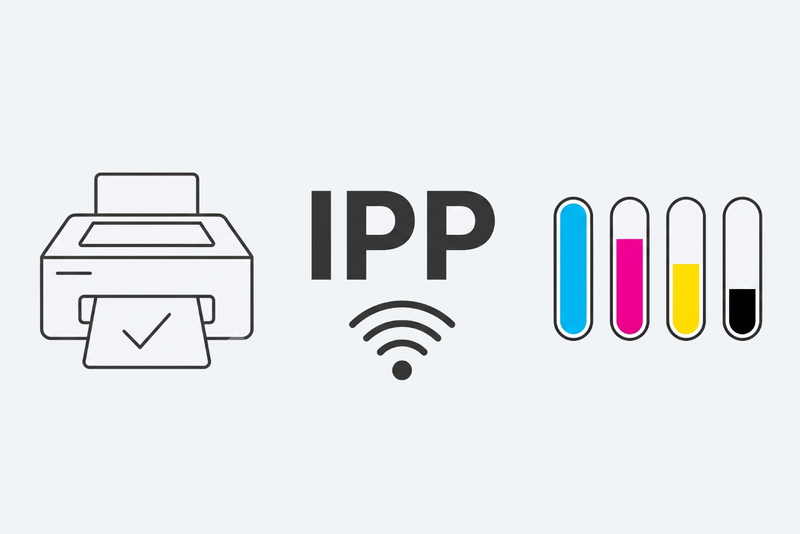
Ink/toner levels and state of your network printers over IPP (AirPrint). Local, no cloud.
Publicado por guim31
- Dispositivos
- Versión 1.0.10
- Requiere Gladys >=4.86.0
- ★ 1
La documentación de esta integración la escribe su autor y, por ahora, solo está disponible en inglés.
This integration monitors your network printers through the standard IPP protocol (Internet Printing Protocol) — the one AirPrint uses. It runs fully locally: no account, no cloud, no API key. It requires Gladys 5.1 or newer.
What you get
One Gladys device per printer, with:
- one sensor per ink or toner cartridge (level in %), with history — so you can chart consumption over time and trigger scenes ("black ink below 10% → notification");
- the printer state:
idle(ready),printing,stopped, with the reason when the printer reports it (stopped (media-empty)= out of paper). The state is watched continuously (sampled every 15 s) and updated as soon as it changes, independently of the interval set for the levels: a print job only lasts a few seconds.
A printer permanently showing
idleis usually normal: that is the state of a powered-on printer with nothing to do. It only changes while printing or when something is wrong (out of paper, jam). The "Test a printer" button shows you live what yours reports at any moment.
Compatibility
Any network printer supporting AirPrint / IPP Everywhere (the vast majority of printers sold since ~2012: HP, Epson, Canon, Brother, Lexmark…). The printer must be on the same network as Gladys, with IPP enabled (it is by default; some menus call it "AirPrint").
Some printers do not advertise their ink levels over IPP: in that case the device only exposes its state.
Configuration
- Install the integration: printers advertising IPP over mDNS are discovered automatically and show up in the Discovery tab.
- If a printer is not found (mDNS blocked, different subnet…), add it to
Printers (manual list): an IP (
192.168.1.20), a hostname (printer.local) or a full URI (ipp://192.168.1.20/ipp/print), separated by commas. - Adjust the refresh interval if needed (900 s by default — ink levels move slowly). It only applies to the levels: the state is watched continuously (every 15 s).
- Pick the language of the sensor names if you wish: by default they are the raw names reported by the printer (usually English, like "black cartridge"); selecting French turns the recognized cartridges into « Encre noire », « Toner cyan »… The setting applies to newly added devices — for an existing device, rename its features from its page, or delete and re-add it (the history of the old features is then lost).
- Add the discovered devices from the Discovery tab.
Tip: give a fixed IP (DHCP reservation) to printers that do not advertise their unique id (UUID) — the integration then falls back to the hostname to identify them.
Actions
- Test a printer — type an IP, hostname or
ipp://URI: the integration queries it live and shows the model, state and detected levels. The fastest way to check an address before adding it to the manual list.
Dashboard widgets
With Gladys 5.1 or newer, the integration offers two widgets in the dashboard editor (under "IPP Printers").
- Printer: one printer at a glance — a gauge per supply (ink, toner, drum…), the state (idle, printing, stopped with its reason), the time of the last reading and the lowest supply, plus a Check button that queries the printer right away and re-publishes its values. Setting: the printer to show (leave empty for the first one added to Gladys). The gauges are bound to the device sensors: they follow the levels live, without waiting for the widget refresh. Limits: at most 5 gauges (the dashboard caps a widget at 8 elements); beyond that, the lowest levels come first. Gauges are green from 25 %, orange below, red under 10 %.
- Supplies: every printer in one list, the most critical first — for each, the state and the lowest supply ("Idle · Black 12 %"), colored by level (red under 10 %, orange under 25 %) — and the number of printers "to watch" (a supply under 25 %). No setting. At most 10 printers are listed.
Both widgets read the last reading made by the integration (every 15 s for the state, at the configured interval for the levels): they never query the printer themselves, except through the Check button. Until a printer has answered since the integration started, its state reads "Waiting for the first reading". The short supply names follow the Sensor names setting ("Black", "Cyan", "Drum"… in English; the raw name reported by the printer otherwise).
Troubleshooting
- Printer not discovered: check that it answers IPP with the "Test a printer" action. If the test fails, check that port 631 is open and that IPP/AirPrint is enabled in the printer settings.
- No ink levels: run "Test a printer", the message tells you which case
you are in. "no supply announced, over IPP nor SNMP" means the printer
keeps its levels for its own app: a firmware limitation, not an
integration one. If SNMP is disabled in the printer network settings,
turning it back on is sometimes enough for the cartridges to show up (the
community name must stay
public). - A single cartridge shows "unknown" (often the black one, on HP): if that cartridge is refilled or third-party, this is by HP design — the firmware refuses to estimate the level of non-genuine cartridges (it shows "?" even on the printer's own screen). The value exists nowhere; with a genuine cartridge the level comes back by itself. The "Test a printer" button shows the raw reported value ("unknown (-2)").
- The printer answers but with an error (HTTP 500, HTTP 426): common on
minimalist firmwares (Epson EcoTank in particular). The integration
automatically tries several request variants (IPP 1.1 then 2.0, with and
without an explicit attribute list) and switches to encrypted IPP
(
ipps://) by itself when the printer requires it (HTTP 426). If everything fails, the "Test a printer" button shows the exact error — paste it on the forum. - Non-standard IPP path: by default the integration tries
/ipp/print,/ippthen/. If your printer uses another path (some CUPS queues for instance), type the full URI:ipp://host:631/the/path. - The integration logs (Gladys UI or
docker logs, withLOG_LEVEL=debugfor full detail) trace every request and every skipped printer.
Parámetros de configuración
Estos son los parámetros que IPP Printers te pide en su pantalla de configuración en Gladys.
| Parámetro | Tipo | Obligatorio | Descripción |
|---|---|---|---|
| How it works | section | No | Printers advertising IPP (any AirPrint-capable printer) are discovered automatically on your network. You can also list printers manually below — useful when mDNS does not reach them. Each printer exposes one sensor per ink or toner cartridge, plus its state. Printers that announce no level over IPP are asked over SNMP instead, the way CUPS reads them. |
| Printers (manual list) | string | No | Optional. IPs, hostnames or ipp:// URIs, separated by commas — e.g. 192.168.1.20, printer.local, ipp://192.168.1.30/ipp/print. |
| Sensor names | select | No | Applies to newly added devices. Printers report their supplies in their own words (usually English): keep them as-is, or translate the recognized cartridges. |
| Levels refresh interval (s) | number | No | How often the ink/toner levels are recorded, in seconds. They move slowly: 900 s (15 min) is plenty. The printer state is watched continuously (sampled every 15 s) and updated as soon as it changes. |
Cómo instalar IPP Printers en Gladys
- En Gladys, abre Integraciones: IPP Printers aparece en el catálogo junto a las integraciones nativas, con una insignia de comunidad.
- Haz clic en Instalar. Gladys descarga la imagen Docker (
ghcr.io/guim31/gladys-ipp:1.1.0), la ejecuta en un entorno aislado del núcleo y genera la interfaz de la integración (dispositivos, descubrimiento y configuración). - Abre la pantalla de Configuración de la integración, rellena los parámetros y guarda.
- También puedes instalarla directamente desde la URL de su repositorio: https://github.com/guim31/gladys-ipp.
IPP Printers requiere Gladys >=5.1.0. El catálogo de Gladys se actualiza cada hora, así que una nueva versión está disponible como máximo una hora después de publicarse.
¿Todavía no usas Gladys? Es gratuito y de código abierto: sigue la guía de instalación para empezar.
Sobre las integraciones externas
IPP Printers es una integración externa: una integración comunitaria empaquetada como contenedor Docker y publicada en GitHub. Gladys la instala con un clic y la ejecuta en un entorno aislado del núcleo. La publica y mantiene guim31, no el equipo principal de Gladys.
- Explorar todas las integraciones externas
- Descubrir las integraciones nativas incluidas en Gladys
- Crear y publicar tu propia integración externa
- Código fuente en GitHub — fuente de esta documentación