Looking for a Domoticz alternative?
Domoticz has run countless Raspberry Pi smart homes. If you want the same open-source, local approach with a modern interface and no scripting, Gladys Assistant is a natural next step.
Domoticz earned its reputation by being light, stable and compatible with a huge range of hardware, from RFXCOM and 433 MHz devices to Zigbee and Z-Wave. Many smart homes have run on it for a decade.
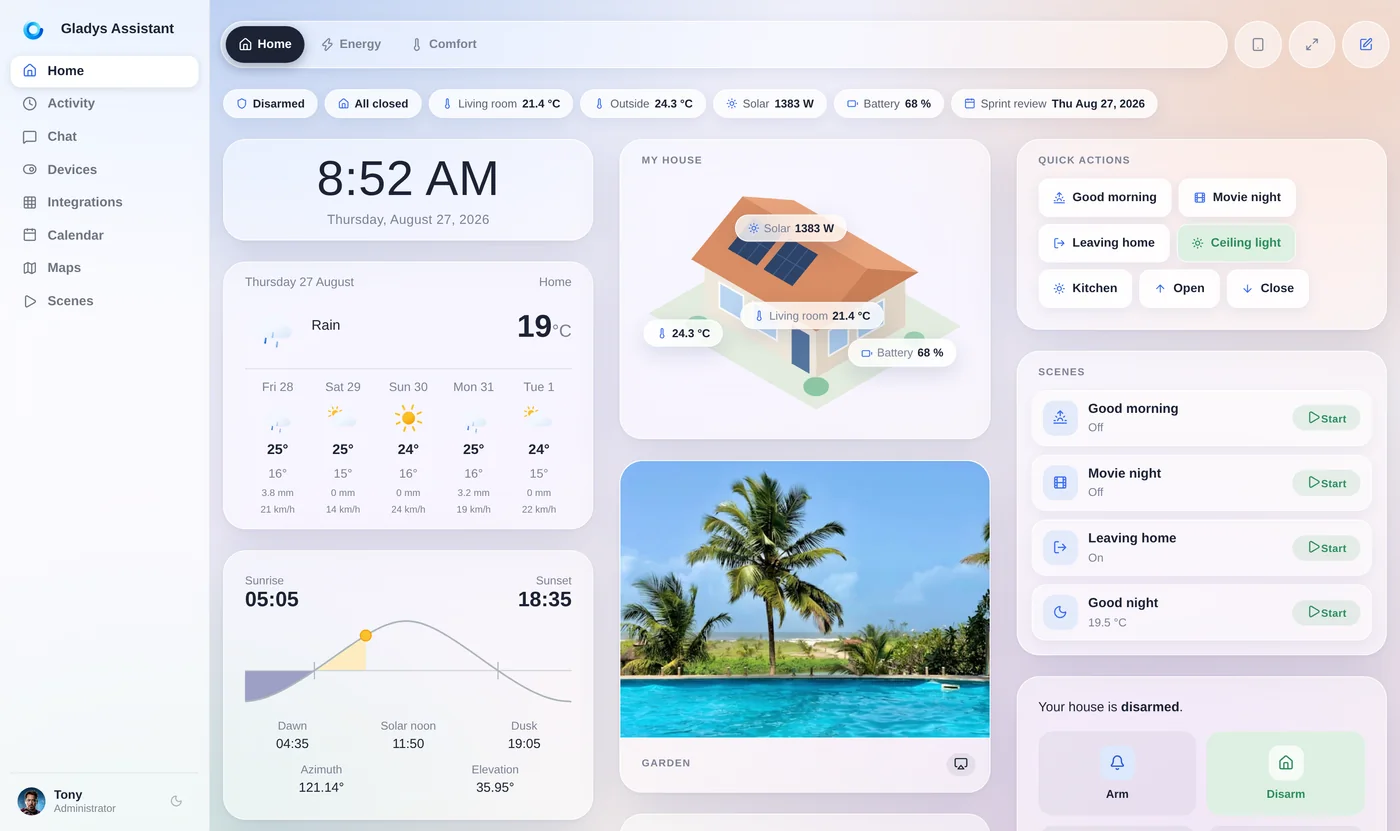
But its interface shows its age, and anything beyond simple timers means Lua, dzVents or Blockly scripts. Gladys Assistant shares the same values, open source, local and lightweight, with a mobile-first interface and automations you build visually.
Why people look for an alternative to Domoticz
Domoticz users who switch usually mention the same things:
- The web interface feels dated, especially on a phone.
- Automations beyond simple timers require scripting in Lua, dzVents or Blockly.
- Dashboards for the rest of the household take work to set up.
- Its community and its catalog of integrations are smaller than Home Assistant's.
If Domoticz still does everything you need, keep it. If you want a fresher experience without giving up open source and local control, read on.
Gladys Assistant vs Domoticz
Two lightweight, open-source and local platforms:
| Gladys Assistant | Domoticz | |
|---|---|---|
| License | Apache 2.0 | GPL v3 |
| Stack | Node.js, Docker | C++, native or Docker |
| Interface | Modern, mobile-first dashboards | Classic web interface |
| Automations | Visual scenes, no code | Timers, Blockly, Lua, dzVents and Python scripts |
| Zigbee | Zigbee2MQTT, installed and managed by Gladys | Through Zigbee2MQTT over MQTT, or plugins |
| AI | AI assistant with Gladys Plus, built-in MCP server | No built-in AI |
| Hardware coverage | Main protocols and popular brands, plus 90+ community integrations | Very broad, including legacy 433 MHz and RFXCOM devices |
Domoticz, still actively maintained with several releases a year, wins on legacy hardware coverage and a very light footprint. Gladys wins on interface, automations without code, Matter and AI.
Why Gladys is a good Domoticz alternative
What changes when you move to Gladys:
Dashboards designed for phones and wall tablets, that the whole household can use.
Triggers, conditions, if/then/else and delays in a visual editor: no Lua or dzVents to maintain.
Gladys installs and wires Zigbee2MQTT and its MQTT broker for you.
Gladys is a Matter controller, ready for the new generation of devices.
Talk to your home with Gladys Plus, or connect Claude through the built-in MCP server.
Gladys runs on a Raspberry Pi, a mini-PC or a NAS with Docker.
How to move from Domoticz to Gladys
A progressive migration:
- Install Gladys on the same Raspberry Pi or on another machine, and list your Domoticz devices by hardware.
- Zigbee: move your devices to Zigbee2MQTT managed by Gladys (a Zigbee dongle can only be used by one of them at a time).
- Z-Wave: run Z-Wave JS UI and connect Gladys to it over MQTT.
- 433 MHz devices: check the RFLink community integration; MQTT can bridge the rest.
- Rebuild your scripts as Gladys scenes, then switch Domoticz off once everything runs in Gladys.
Check the Works with Gladys page first: Domoticz supports some legacy hardware Gladys doesn't.
Same values, a fresher experience
Domoticz and Gladys agree on the essentials: open source, local, lightweight. Gladys brings what Domoticz users most often miss: an interface that feels current, automations without scripting, Matter, and optional AI.
Gladys is free. Gladys Plus is an optional subscription for encrypted remote access, backups, Alexa and Google Home, and the AI assistant.
Go further
Compare Gladys with other platforms:
Frequently asked questions
What is a good alternative to Domoticz?
Gladys Assistant is a free, open-source and local platform with a modern mobile interface and visual scenes instead of scripts. Home Assistant and openHAB are other open-source options, more extensive but also more complex.
Is Gladys as lightweight as Domoticz?
Gladys runs comfortably on a Raspberry Pi 4 or 5, a mini-PC or a NAS with Docker. Domoticz has an even smaller footprint, but Gladys remains light enough for a small, always-on machine.
Do I need to write scripts in Gladys?
No. Gladys automations are scenes built in a visual editor, with triggers, conditions, if/then/else and delays. There's no Lua or dzVents to write.
Can I keep my Zigbee devices when leaving Domoticz?
Yes. Zigbee devices can be paired with the Zigbee2MQTT instance Gladys installs and manages. If you already use Zigbee2MQTT with Domoticz, the devices are the same; only one platform can use the dongle at a time.
Does Gladys support 433 MHz devices like Domoticz?
Partly, through the RFLink community integration. Domoticz has broader support for legacy 433 MHz and RFXCOM hardware, so check your devices before migrating.
Open source, local, and modern
Gladys is free and installs with a single Docker command. Try it next to Domoticz and see the difference.