RTE Jours signalés smart home integration, free and open source
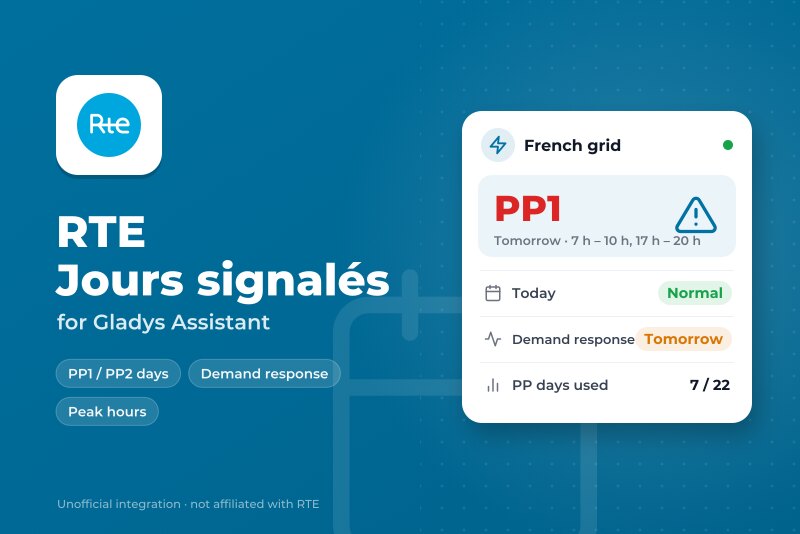
RTE PP days and demand response days of the French grid: today, tomorrow, peak periods.
Published by William-De71
- Devices
- Version 0.1.0
- Requires Gladys >=5.3.0
- ★ 0
Overview
This integration shows in Gladys the days RTE flags on the French power grid:
- the PP days of the capacity mechanism (from 1 November 2026): up to 22 days per winter, from 1 November to 31 March, on weekdays except public holidays. On those days, the peak periods run from 7 to 10 a.m. and from 5 to 8 p.m. RTE announces them the day before at 9:30, sometimes two days ahead;
- the demand response days of the demand response tender (explicit, implicit), published around 11:00 for the next day.
Some suppliers and aggregators reward the savings made on those days. With the scene triggers, Gladys can lower the heating, switch the water heater off or move the car charging during the peak periods.
The data comes from the official RTE APIs, free of charge, with your own application. The integration only reads RTE at the publication times, a few times a day.
Requirements
- Gladys 5.3.0 or newer.
- A free account on data.rte-france.com.
- An RTE application subscribed to the Signal API (PP days), to the Demand Response Signal API (demand response), or to both.
Configuration
- On data.rte-france.com, open the Signal API and click Subscribe to API. Create an application (type Web / Server).
- Do the same for the Demand Response Signal API, attaching it to the same application.
- In My applications, copy the client id and the client secret of the application into the configuration of the integration.
- Click Test the connection: the message gives the state of each API, and whether today and tomorrow are PP days.
| Field | Role |
|---|---|
| Client id | The client id of your RTE application |
| Client secret | The secret of the application, never shown again nor written to the logs |
| Language of the device texts | Names of the devices and features; automatic: the one of the dashboard |
Usage
Devices
In Discovery, add the devices offered (one per API the application is subscribed to).
RTE PP days: today, tomorrow, the day after, peak period now, PP days of the season and left. RTE demand response days: today, tomorrow and flagged days of the year.
| Value | Badge | Meaning |
|---|---|---|
| 0 | No risk | Normal day, or not flagged |
| 1 | Low | Not announced yet (a working day of the season, or not published yet) |
| 3 | High | PP day, flagged day, or peak period under way |
In a scene, compare these values: "PP day tomorrow" equal to 3, "Peak period now" equal to 3.
Dashboard widgets
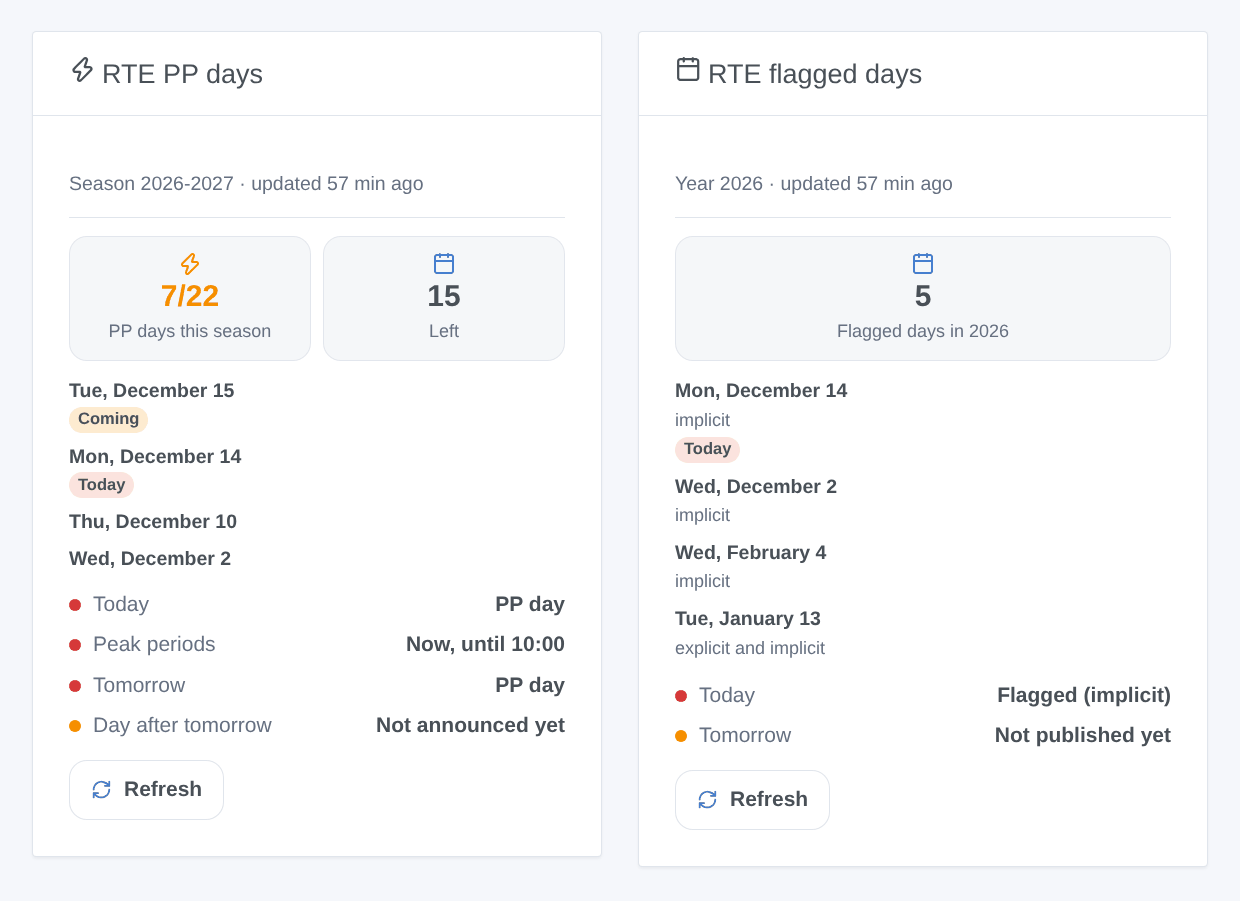
- RTE PP days: today, tomorrow, the day after, peak periods, PP days of the season out of 22, latest PP days, Refresh button.
- RTE flagged days: today and tomorrow with the kind, flagged days of the year, Refresh button.
Scenes
Triggers:
- A PP day is announced: filter today, tomorrow or the day after. Variables: day, days from today, PP days of the season and left.
- A peak period starts / ends: at 7:00 and 17:00, at 10:00 and 20:00 of a PP day; filter morning or evening.
- A demand response day is flagged: filters day and kind (explicit, implicit).
Each day fires once, even if the integration restarts.
Examples:
- When a PP day is announced for tomorrow → notify "PP day tomorrow".
- When a peak period starts → lower the radiators and switch the water heater off; when it ends → restore everything.
- When an implicit demand response day is flagged → move the car charging after 8 p.m.
Transport
Cloud: the integration reads the RTE APIs over HTTPS with your client id and secret. Nothing about your home is sent. The days are counted in French time.
Troubleshooting
- "Credentials refused": copy the client id and secret again from "My applications" on data.rte-france.com.
- "API not subscribed": the application is not subscribed to that API. Subscribe it from the page of the API, then click Test the connection (otherwise the integration tries again every 6 hours).
- Only one device in Discovery: expected when the application is subscribed to one API only.
- "Not announced yet" at 9:00: RTE announces the PP days around 9:30; the integration reads at 9:45, then every 30 minutes while tomorrow is unknown.
- Off season (April to October): no PP day is possible, the values stay at 0.
- To report a problem, open an issue on GitHub with the versions of Gladys and of the integration and the result of "Test the connection".
Configuration settings
These are the settings RTE Jours signalés asks for in its configuration screen in Gladys.
| Setting | Type | Required | Description |
|---|---|---|---|
| Your RTE application | section | No | The integration reads the official RTE APIs, free of charge. 1. Create an account on data.rte-france.com. 2. Open the “Signal” API (PP days) and the “Demand Response Signal” API, and click “Subscribe to API” on each, attaching both to the same new application (Web / Server). 3. In “My applications”, copy the client id and the client secret of that application here. |
| Client id | string | Yes | |
| Client secret | secret | Yes | |
| Options | section | No | Only one of the two APIs is fine: the integration offers the device of each API your application is subscribed to. |
| Language of the device texts | select | No | Names of the devices and features, and messages of the button below. Automatic: the language of the dashboard once a widget is shown. |
How to install RTE Jours signalés in Gladys
- In Gladys, open Integrations: RTE Jours signalés appears in the catalog, next to the native integrations, with a community badge.
- Click Install. Gladys pulls the Docker image (
ghcr.io/william-de71/gladys-rte-jours-signales:0.1.0), starts it in a sandbox isolated from the core, and generates the integration's interface (devices, discovery and configuration). - Open the Configuration screen of the integration, fill in the settings, and save.
- You can also install it directly from its repository URL: https://github.com/William-De71/gladys-rte-jours-signales.
RTE Jours signalés requires Gladys >=5.3.0. The catalog inside Gladys refreshes every hour, so a new version becomes available at most one hour after its release.
Not running Gladys yet? It is free and open source: follow the installation guide to get started.
About external integrations
RTE Jours signalés is an external integration: a community integration packaged as a Docker container and published on GitHub, that Gladys installs in one click and runs in a sandbox isolated from its core. It is published and maintained by William-De71, not by the Gladys core team.
- Browse all integrations, native and community
- Build and publish your own external integration
- Source code on GitHub — source of this documentation