Moon phase smart home integration, free and open source
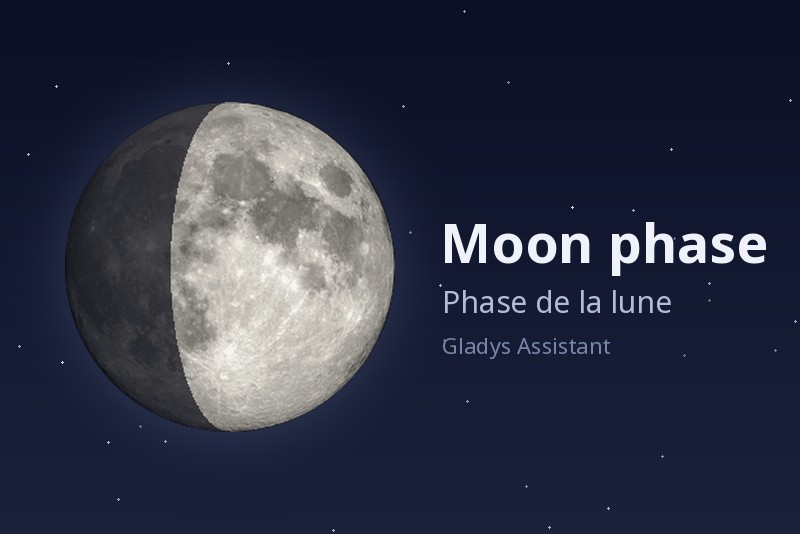
Moon phase widget: illumination, moonrise and moonset, upcoming lunar events.
Published by William-De71
- Devices
- Version 1.0.0
- Requires Gladys >=5.1.1
- ★ 0
This integration adds a "Moon phase" dashboard widget to Gladys: today's phase, the illumination and age of the moon, its lit disk, moonrise and moonset, and the upcoming lunar events.
Ready to use
Nothing to configure: everything is computed locally from the location of your house, with no account, no key and no internet access.
The house must have a location: set it in Settings → Houses.
Add the widget
Edit a dashboard, pick Moon phase among the integration widgets, then set:
| Setting | What it does |
|---|---|
| House | Name of the house whose location is used. Leave empty for the first house with a location (the single-house case). |
| Display details | Shows the list under the moon (distance, trajectory, constellation, upcoming events). Uncheck to keep only the phase, the disk, moonrise and moonset. |
| Compute the values at midnight | Computes the illumination, distance, age and countdowns at midnight, like lunar calendars, so both can be compared line by line. Moonrise and moonset do not change. |
What the widget shows
- The phase (New Moon, Waxing Crescent, First Quarter, Waxing Gibbous, Full Moon…), the illuminated percentage and the age of the moon (days since the last new moon).
- The moon disk (a NASA photo) with its lit part.
- Moonrise and moonset of the day, in the timezone of Gladys.
--:--when the moon does not rise or set that day (about one day a month). - Today: Earth-Moon distance, trajectory (ascending or descending), constellation (sidereal zodiac, like lunar calendars) and the next node.
- Upcoming: full moon, new moon, perigee, apogee and next lunar eclipse, with the number of days and the date.
The widget refreshes every 10 minutes and right after midnight.
FAQ
The widget says no house has a location. Set the location of a house in Settings → Houses.
The widget says "No house named …". The name typed in the House setting matches no house: the message lists the names to use.
The times are off. Check the timezone of Gladys (Settings → System); the integration uses it. Restart the integration after changing it.
My language is not English, French or German. The widget is then shown in English.
Configuration settings
These are the settings Moon phase asks for in its configuration screen in Gladys.
| Setting | Type | Required | Description |
|---|---|---|---|
| Ready to use | section | No | Nothing to configure: everything is computed locally from the location of your house, with no account and no internet access. Add the "Moon phase" widget to a dashboard. The house must have a location (Settings → Houses). |
How to install Moon phase in Gladys
- In Gladys, open Integrations: Moon phase appears in the catalog, next to the native integrations, with a community badge.
- Click Install. Gladys pulls the Docker image (
ghcr.io/william-de71/gladys-moon-phase:1.0.0), starts it in a sandbox isolated from the core, and generates the integration's interface (devices, discovery and configuration). - Open the Configuration screen of the integration, fill in the settings, and save.
- You can also install it directly from its repository URL: https://github.com/William-De71/gladys-moon-phase.
Moon phase requires Gladys >=5.1.1. The catalog inside Gladys refreshes every hour, so a new version becomes available at most one hour after its release.
Not running Gladys yet? It is free and open source: follow the installation guide to get started.
About external integrations
Moon phase is an external integration: a community integration packaged as a Docker container and published on GitHub, that Gladys installs in one click and runs in a sandbox isolated from its core. It is published and maintained by William-De71, not by the Gladys core team.
- Browse all external integrations
- Discover the native integrations built into Gladys
- Build and publish your own external integration
- Source code on GitHub — source of this documentation