Art-Net smart home integration, free and open source
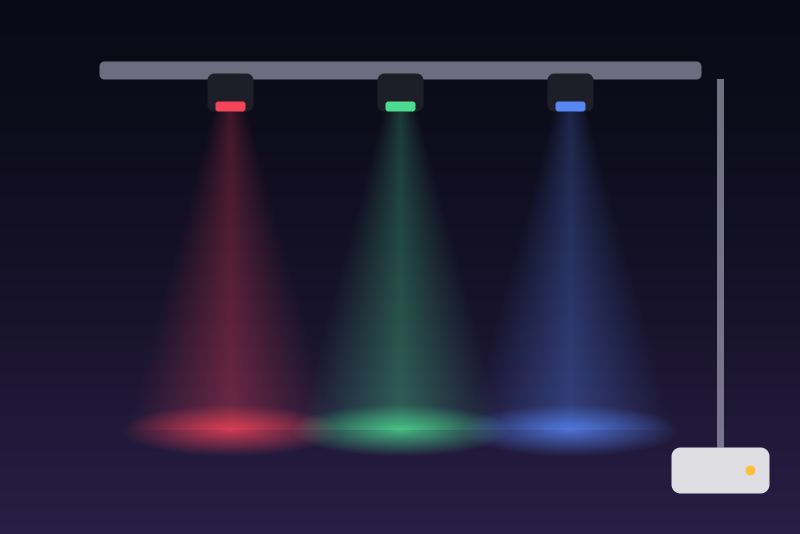
DMX stage lighting through an Art-Net node, on the local network.
Published by LM1LC3N7
- Devices
- Version 0.1.1
- Requires Gladys >=5.1.0
- ★ 0
Drives DMX stage lighting (dimmers, RGB, RGBW and white fixtures) from Gladys through an Art-Net node: the box that turns your local network into DMX512 lines. Everything stays on the local network (UDP port 6454), with no account and no cloud.
This integration has never been tested with a real node: only against a simulated node on the same machine. Please report how it behaves with yours. It is not affiliated with Artistic Licence nor with any lighting brand.
Art-Net™ Designed by and Copyright Artistic Licence. Art-Net is a protocol of Artistic Licence Engineering Ltd.
What you need
- An Art-Net node (Art-Net 3 or 4) on your network, with a fixed IP address (set it in your router or in the node).
- The DMX address of each fixture (set on the fixture: a display, DIP switches) and the universe of the DMX line it is plugged on (set in the node).
Configuration
-
Node IP address: the address of the node, for example
192.168.1.60. The port is 6454 unless you add another (192.168.1.60:6455). A broadcast address (ending in.255,2.255.255.255...) is refused: Art-Net 4 sends DMX to the node itself. -
Fixtures: one entry per fixture, separated by
;:[universe/]address profile name. Example:1 rgb Living room; 4 dimmer Bar; 2/10 cct Desk.-
universe: 1 to 32767 (the Port-Address of the node), 1 when left out; 0 is accepted when typed (
0/4): Art-Net 4 deprecates it, but many nodes still use it; -
address: 1 to 512, the first DMX channel of the fixture;
-
profile: the order of its channels:
Profile Channels Gladys features dimmerintensity on/off, brightness rgbred, green, blue on/off, brightness, colour rgbwred, green, blue, white on/off, brightness, colour drgbintensity, red, green, blue on/off, brightness, colour drgbwintensity, red, green, blue, white on/off, brightness, colour cctcold white, warm white on/off, brightness, white temperature -
name: up to 40 characters (optional:
Fixture 1/4otherwise).
An entry that cannot be read, that runs past channel 512 or that overlaps an earlier fixture is skipped: the status gives its position and the reason. At most 64 fixtures on 16 universes.
-
-
Language of the default names: the names given to fixtures without one and to the features.
Save: the fixtures appear in Discovery (one light each). Add them.
Assumed state
Art-Net sends DMX one way: a fixture never reports its state. Gladys shows the last command sent, and the badge of each fixture says the state is assumed. If someone changes a fixture with a lighting desk or its own buttons, Gladys does not know.
After a restart of the integration, every fixture is assumed off: nothing is sent until the first command, and that first command sends the whole universe, so the other fixtures of the universe go to 0 (Gladys shows them off). The DMX channels of a universe that are not in the fixtures list are sent at 0.
How the frames are sent
- A universe starts being sent at the first command, "off" or Blackout that touches it. Its frame (the whole universe, from channel 1 to the last channel used) then leaves after each change, 25 ms after the previous frame at the earliest (40 frames a second at most, the DMX512 limit is 44), and again every 900 ms without change, as Art-Net asks, until the integration stops.
- A frame is sent by unicast to the node address, from port 6454 when it is free (else from another port, said in the status: a few nodes ignore it).
- A command is answered once its frame left the network card. If it could not leave (network error), "on", brightness, colour and temperature are undone and the answer says nothing was sent.
Off and Blackout
"Off" (on/off at 0, or brightness 0) sets every channel of the fixture to 0. Blackout (button in the configuration, and scene action "Art-Net blackout") sets every known fixture, and every universe already sent, to 0.
They need no option and no configuration read: the node address and the
fixtures are also kept in /data, read as soon as the integration starts, so
they work right after a restart, before Gladys gives the configuration (before
it is read, they wait up to 1.5 s for a /data read in progress). They are not
held back by the 32-universe bound of a session. If a frame cannot leave, the
900 ms keep-alive tries it again until it does; when it finally leaves, Gladys
is told the fixture is off. Their only refusals:
- no node address known (none configured, nothing in
/data); - "off" only: a fixture not in the configuration; before the configuration is
read, a fixture not in
/data, or/dataunreadable, or/datastill not read after 1.5 s; - Blackout only: no fixture and no universe known (same cases);
- the integration is stopping.
If the node address in the configuration becomes invalid, "off" and Blackout go to the last valid one.
Buttons
- Test the node: sends an ArtPoll and shows the name the node gives in its ArtPollReply (3 s at most, once every 10 s). Some nodes answer only to port 6454, or not at all: this does not stop the DMX frames.
- Blackout (all fixtures at 0): see above.
Status
- Ready: N fixture(s), frames go to address:port: the configuration is valid.
- Frames do not leave for ... (code): the network refuses the datagrams (cable, address); they are tried again every second.
- Configuration not read: Gladys did not give it, tried again after 5 s, then up to every 5 min.
- Entries skipped: the position and reason of each entry in error.
- Storage /data unreadable / not writable: read again every 10 s; until then "off" and Blackout need the configuration.
Limits
- At most 32 universes started in one session (after several changes of the configuration): beyond, "on", brightness, colour and temperature are refused until the integration restarts; "off" and Blackout are not.
- One node. Several nodes, ArtPoll discovery, ArtSync and RDM are not done.
- 8-bit channels only (no 16-bit "fine" channels), no moving heads, no effects.
- Nothing is read back: the state is the last command sent.
Privacy
Nothing leaves your local network. /data keeps the node address and the
universe, address and profile of each fixture (not their names).
Configuration settings
These are the settings Art-Net asks for in its configuration screen in Gladys.
| Setting | Type | Required | Description |
|---|---|---|---|
| Getting started | section | No | Give the IP address of your Art-Net node (the box that turns the network into DMX lines, fixed in your router) and list your fixtures. Art-Net never reports a state: Gladys shows the last command sent. Blackout (button below, or scene action) sets every fixture to 0. |
| Node IP address | string | Yes | IPv4 address of the Art-Net node, with an optional port (6454 by default). Never a broadcast address: Art-Net sends DMX to the node itself. |
| Fixtures | string | No | One entry per fixture, separated by ; written [universe/]address profile name. Universe 1 to 32767 (1 when left out; 0 accepted), address 1 to 512 (first DMX channel), profile: dimmer, rgb, rgbw, drgb, drgbw (d = intensity channel first) or cct (cold then warm white). |
| Language of the default names | select | No |
How to install Art-Net in Gladys
- In Gladys, open Integrations: Art-Net appears in the catalog, next to the native integrations, with a community badge.
- Click Install. Gladys pulls the Docker image (
ghcr.io/lm1lc3n7/gladys-artnet:0.1.1), starts it in a sandbox isolated from the core, and generates the integration's interface (devices, discovery and configuration). - Open the Configuration screen of the integration, fill in the settings, and save.
- You can also install it directly from its repository URL: https://github.com/LM1LC3N7/gladys-artnet.
Art-Net requires Gladys >=5.1.0. The catalog inside Gladys refreshes every hour, so a new version becomes available at most one hour after its release.
Not running Gladys yet? It is free and open source: follow the installation guide to get started.
About external integrations
Art-Net is an external integration: a community integration packaged as a Docker container and published on GitHub, that Gladys installs in one click and runs in a sandbox isolated from its core. It is published and maintained by LM1LC3N7, not by the Gladys core team.
- Browse all integrations, native and community
- Build and publish your own external integration
- Source code on GitHub — source of this documentation