Moon phase Smart-Home-Integration, kostenlos und Open Source
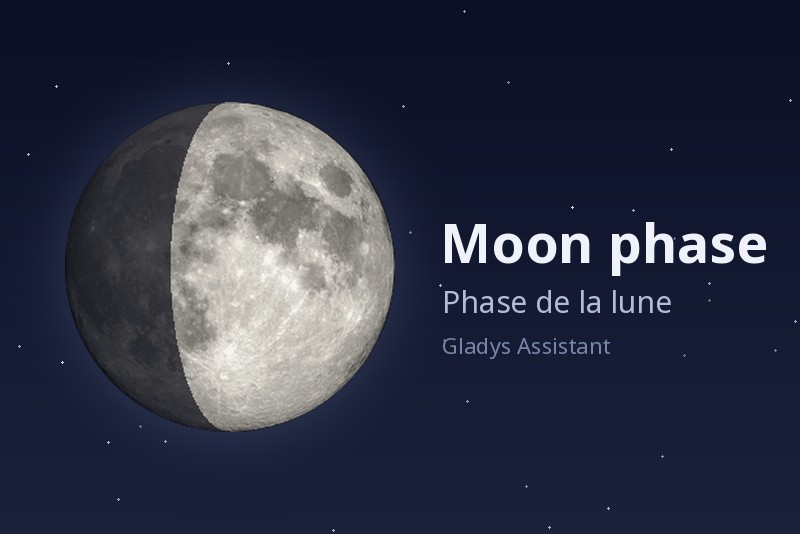
Mondphasen-Widget: Beleuchtung, Mondauf- und -untergang, nächste Mondereignisse.
Veröffentlicht von William-De71
- Geräte
- Version 1.0.0
- Erfordert Gladys >=5.1.1
- ★ 0
Die Dokumentation dieser Integration wird von ihrem Autor geschrieben und ist bisher nur auf Englisch verfügbar.
This integration adds a "Moon phase" dashboard widget to Gladys: today's phase, the illumination and age of the moon, its lit disk, moonrise and moonset, and the upcoming lunar events.
Ready to use
Nothing to configure: everything is computed locally from the location of your house, with no account, no key and no internet access.
The house must have a location: set it in Settings → Houses.
Add the widget
Edit a dashboard, pick Moon phase among the integration widgets, then set:
| Setting | What it does |
|---|---|
| House | Name of the house whose location is used. Leave empty for the first house with a location (the single-house case). |
| Display details | Shows the list under the moon (distance, trajectory, constellation, upcoming events). Uncheck to keep only the phase, the disk, moonrise and moonset. |
| Compute the values at midnight | Computes the illumination, distance, age and countdowns at midnight, like lunar calendars, so both can be compared line by line. Moonrise and moonset do not change. |
What the widget shows
- The phase (New Moon, Waxing Crescent, First Quarter, Waxing Gibbous, Full Moon…), the illuminated percentage and the age of the moon (days since the last new moon).
- The moon disk (a NASA photo) with its lit part.
- Moonrise and moonset of the day, in the timezone of Gladys.
--:--when the moon does not rise or set that day (about one day a month). - Today: Earth-Moon distance, trajectory (ascending or descending), constellation (sidereal zodiac, like lunar calendars) and the next node.
- Upcoming: full moon, new moon, perigee, apogee and next lunar eclipse, with the number of days and the date.
The widget refreshes every 10 minutes and right after midnight.
FAQ
The widget says no house has a location. Set the location of a house in Settings → Houses.
The widget says "No house named …". The name typed in the House setting matches no house: the message lists the names to use.
The times are off. Check the timezone of Gladys (Settings → System); the integration uses it. Restart the integration after changing it.
My language is not English, French or German. The widget is then shown in English.
Konfigurationseinstellungen
Diese Einstellungen fragt Moon phase in seinem Konfigurationsbildschirm in Gladys ab.
| Einstellung | Typ | Pflichtfeld | Beschreibung |
|---|---|---|---|
| Sofort einsatzbereit | section | Nein | Nichts zu konfigurieren: alles wird lokal aus dem Standort deines Zuhauses berechnet, ohne Konto und ohne Internetzugang. Füge das Widget „Mondphase“ einem Dashboard hinzu. Das Zuhause muss einen Standort haben (Einstellungen → Zuhause). |
So installierst du Moon phase in Gladys
- Öffne in Gladys Integrationen: Moon phase erscheint im Katalog neben den nativen Integrationen, mit einem Community-Badge.
- Klicke auf Installieren. Gladys lädt das Docker-Image (
ghcr.io/william-de71/gladys-moon-phase:1.0.0) herunter, startet es in einer vom Kern isolierten Sandbox und erzeugt die Oberfläche der Integration (Geräte, Erkennung und Konfiguration). - Öffne den Bildschirm Konfiguration der Integration, fülle die Einstellungen aus und speichere.
- Du kannst sie auch direkt über die URL ihres Repositorys installieren: https://github.com/William-De71/gladys-moon-phase.
Moon phase benötigt Gladys >=5.1.1. Der Katalog in Gladys wird stündlich aktualisiert, eine neue Version ist also spätestens eine Stunde nach ihrer Veröffentlichung verfügbar.
Du nutzt Gladys noch nicht? Es ist kostenlos und Open Source: folge der Installationsanleitung, um loszulegen.
Über externe Integrationen
Moon phase ist eine externe Integration: eine Community-Integration, die als Docker-Container verpackt und auf GitHub veröffentlicht wird. Gladys installiert sie mit einem Klick und führt sie in einer vom Kern isolierten Sandbox aus. Sie wird von William-De71 veröffentlicht und gepflegt, nicht vom Gladys-Kernteam.
- Alle externen Integrationen durchsuchen
- Die nativen Integrationen entdecken, die in Gladys eingebaut sind
- Deine eigene externe Integration bauen und veröffentlichen
- Quellcode auf GitHub — Quelle dieser Dokumentation