Deutsche Bahn Smart-Home-Integration, kostenlos und Open Source
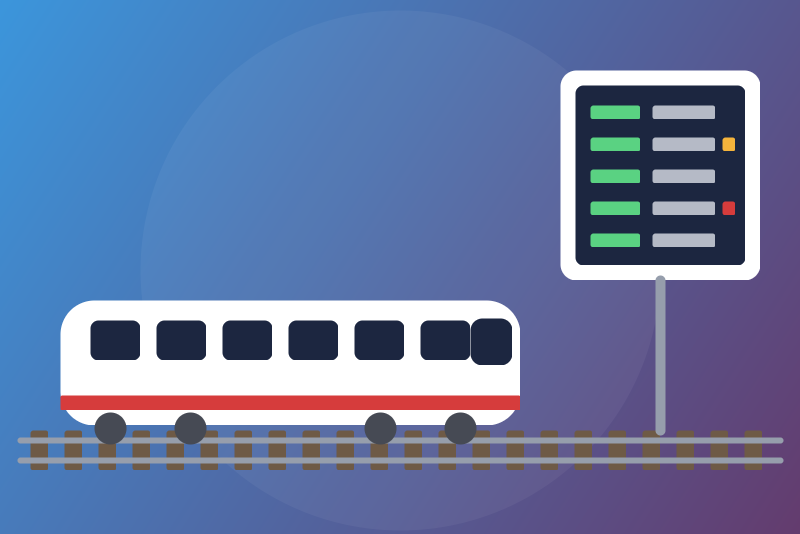
Unofficial: Deutsche Bahn departures, delays and cancellations, official API with your key.
Veröffentlicht von LM1LC3N7
- Geräte
- Version 0.1.1
- Erfordert Gladys >=5.3.0
- ★ 0
Die Dokumentation dieser Integration wird von ihrem Autor geschrieben und ist bisher nur auf Englisch verfügbar.
Unofficial integration, not affiliated with Deutsche Bahn. It follows up to three stations of Deutsche Bahn (Germany) and gives, for each one, the next departure, its delay and the disrupted departures, plus a departure board widget. Read-only: nothing is booked or changed.
The data comes from the official Timetables API of the DB API Marketplace, with your own free key. The integration never uses the private API of the DB Navigator app.
This integration was built from the API documentation and tested with a fake Gladys and a fake API only: it was never tested with real DB credentials. The first users' feedback is welcome on the forum.
1. Get your free key
- Create an account on the DB API Marketplace.
- Under Anwendungen (applications), create an application (a name is enough). Note its Client ID and its Client Secret (the API key).
- In the Katalog, open the Timetables API, click Abonnieren (subscribe), choose the Free plan and your application.
2. Configure
- Client ID and API key (Client Secret): both are needed; with only
one of them nothing is sent. Kept by Gladys in its database, never shown
again, sent only to the DB API Marketplace (in the
DB-Client-IdandDB-Api-Keyheaders). - Station 1 to 3: a name (
Köln Hbf), an EVA number (8000207) or a DS100 code (KK). The Find a station button lists the stations DB knows for a name, with their EVA number and DS100 code. When a name matches several stations, enter the EVA number. - Lines (optional): lines or categories separated by commas
(
RE 5, S 12, ICE). Direction (optional): part of the name of a station the train goes through or to (Koblenz). - Read interval: 2 minutes by default (1 to 15).
- Departures shown: the next 60 minutes by default (15 to 180).
- Disrupted from: 5 minutes of delay by default.
- Language of the values: English or French.
Test the credentials sends one request to DB (at most every 30 seconds) and says whether the Client ID and the API key are accepted.
3. The devices
Each station appears in the Discovery tab once DB has found it (device
name DB <station>, with the filters in brackets). Features, all read-only:
| Feature | Value |
|---|---|
| Next departure | text, e.g. 14:05 RE 5 → Koblenz Hbf, pl. 4 instead of 3, +4 min |
| Next departure in | minutes until the next departure that runs (with its delay) |
| Delay of the next departure | minutes, 0 when on time (live data only) |
| Disrupted departures | departures of the window cancelled or late from the threshold (live data only) |
The time shown is the planned time, local time of Germany. A cancelled train is not "the next departure": the next one that runs is. A train planned in the two hours before and still waiting (late) is shown too; one later than that is missed.
A train for which DB reports no change is on time: that is how DB's live data
works (/fchg lists the changes). DB does not guarantee that every tracked
train is in it, and its data does not tell a train on time from a train it
does not track: both show "on time".
The values are published again every minute from what was read (no request): Next departure in counts down between two reads.
What is not known is not published (the last value stays; Gladys has no "unknown"):
- no departure in the window: the text says so, Next departure in and Delay are not updated (never a 0 for "none");
- live data of DB older than 10 minutes (2.5 intervals when longer): the text ends with "timetable only", delay and disruptions are not updated;
- no timetable for the current hour nor the next ones (DB answers 404), or a timetable hour missing: nothing is published, the status says so;
- the hour repeated by the autumn change of time (02:00 to 03:00 winter time): the times are ambiguous, nothing is published until 03:00. In the hour after it, a train of the repeated hour still late is shown with a delay one hour off (one hour a year).
4. Dashboard
The Deutsche Bahn departures widget shows the next 8 departures of a station, with the delay, the platform and the cancellations, the time of the live data and the attribution of the data. It uses what the integration already read: opening it sends no request to DB.
5. How it reads DB, and its limits
- Every interval, for each station: the live changes (
/fchg), one request; the timetable of each hour of the window (/plan) once an hour; the station itself once (kept across restarts). The two hours before are read last, once (a past timetable does not change), and are optional: an error on them (asked again 15 minutes later) never stops the station from being read; only a train still late from then may be missed. - At most one request at a time, 1.5 s apart (40 a minute at most, the free plan allows 60). A restart, a reconnection, a save of the form or the test button does not make the reads come sooner than the interval (a changed station waits 30 s after the last read). When /data cannot be read at start, the first read waits a whole interval.
- HTTP 429, a 5xx on the station request, or a 5xx on every station of a round: every request waits (Retry-After when DB gives it, otherwise 1 minute doubling up to 6 hours), kept across restarts. A 5xx on the timetable of one station only: that station waits (Retry-After when DB gives it, up to 6 hours; otherwise 1 minute doubling up to 30 minutes), the others are read as usual.
- HTTP 401/403 on the station request: the credentials are refused. The integration stops and does not try them again by itself, even after a restart; enter other credentials or press Test the credentials (a success lifts the stop). A 401/403 on a timetable page is checked on the station request first: if the credentials are accepted there, only that station waits (5 minutes, doubling up to 1 hour).
- No station is started after 90 s in a round; the station left goes first at the next round.
- DB gives the timetable a limited time ahead only (hours far ahead have no plan yet: asked again 15 minutes later).
6. What is kept in /data
/data/deutsche-bahn.json: the time of the last round, a pause, a refusal
(8 bits of a salted hash of the credentials, nothing more) and the stations
found (name, EVA number, DS100 code). No credential. When the file cannot be
read, it is not overwritten and is read again every 10 seconds; a file that
does not parse is moved aside to deutsche-bahn.json.bad first.
Data and license
Timetable data: Deutsche Bahn AG, through the DB API Marketplace, under the Creative Commons Attribution 4.0 license (CC BY 4.0). The data is modified: the planned timetable and the live changes are merged, filtered by line and direction, and summarised (next departure, delay in whole minutes, count of disrupted departures). The widget shows the time of the live data it displays.
Konfigurationseinstellungen
Diese Einstellungen fragt Deutsche Bahn in seinem Konfigurationsbildschirm in Gladys ab.
| Einstellung | Typ | Pflichtfeld | Beschreibung |
|---|---|---|---|
| DB API Marketplace application | section | Nein | The departures come from the official Timetables API of Deutsche Bahn. Its free plan needs an account on the DB API Marketplace: create an application, subscribe it to the Timetables API (plan Free), then copy its Client ID and its API key (Client Secret) here. The integration sends at most 40 requests a minute (the plan allows 60). Data: Deutsche Bahn AG, CC BY 4.0. |
| Client ID | secret | Nein | The Client ID of your DB API Marketplace application. Kept by Gladys in its database, never shown again, sent only to the DB API Marketplace. |
| API key (Client Secret) | secret | Nein | The API key of the same application. Kept by Gladys in its database, never shown again, sent only to the DB API Marketplace. |
| Stations | section | Nein | Up to three stations, each a device with its next departure, its delay and the disrupted departures. A station is a name ("Köln Hbf"), an EVA number ("8000207") or a DS100 code ("KK"): the Find a station button gives them. Optional filters: the lines ("RE 5, S 12, ICE") and a station the train goes through or to ("Koblenz"). |
| Station 1 | string | Nein | |
| Lines of station 1 | string | Nein | Optional, separated by commas: a line (RE 5, S 12) or a category (ICE, IC, RE). |
| Direction of station 1 | string | Nein | Optional: only the trains that go through or to this station (part of its name). |
| Station 2 | string | Nein | |
| Lines of station 2 | string | Nein | Optional, separated by commas: a line (RE 5, S 12) or a category (ICE, IC, RE). |
| Direction of station 2 | string | Nein | Optional: only the trains that go through or to this station (part of its name). |
| Station 3 | string | Nein | |
| Lines of station 3 | string | Nein | Optional, separated by commas: a line (RE 5, S 12) or a category (ICE, IC, RE). |
| Direction of station 3 | string | Nein | Optional: only the trains that go through or to this station (part of its name). |
| Options | section | Nein | The live changes are read every interval (one request per station, the timetable once an hour). Delays and disruptions are published only with live data of the last 10 minutes. |
| Read interval (minutes) | number | Nein | |
| Departures shown (next minutes) | number | Nein | |
| Disrupted from (minutes late) | number | Nein | |
| Language of the values | select | Nein | Language of the feature names and of the published texts. |
So installierst du Deutsche Bahn in Gladys
- Öffne in Gladys Integrationen: Deutsche Bahn erscheint im Katalog neben den nativen Integrationen, mit einem Community-Badge.
- Klicke auf Installieren. Gladys lädt das Docker-Image (
ghcr.io/lm1lc3n7/gladys-deutsche-bahn:0.1.1) herunter, startet es in einer vom Kern isolierten Sandbox und erzeugt die Oberfläche der Integration (Geräte, Erkennung und Konfiguration). - Öffne den Bildschirm Konfiguration der Integration, fülle die Einstellungen aus und speichere.
- Du kannst sie auch direkt über die URL ihres Repositorys installieren: https://github.com/LM1LC3N7/gladys-deutsche-bahn.
Deutsche Bahn benötigt Gladys >=5.3.0. Der Katalog in Gladys wird stündlich aktualisiert, eine neue Version ist also spätestens eine Stunde nach ihrer Veröffentlichung verfügbar.
Du nutzt Gladys noch nicht? Es ist kostenlos und Open Source: folge der Installationsanleitung, um loszulegen.
Über externe Integrationen
Deutsche Bahn ist eine externe Integration: eine Community-Integration, die als Docker-Container verpackt und auf GitHub veröffentlicht wird. Gladys installiert sie mit einem Klick und führt sie in einer vom Kern isolierten Sandbox aus. Sie wird von LM1LC3N7 veröffentlicht und gepflegt, nicht vom Gladys-Kernteam.
- Alle Integrationen durchsuchen, native und aus der Community
- Deine eigene externe Integration bauen und veröffentlichen
- Quellcode auf GitHub — Quelle dieser Dokumentation