Autarco Smart-Home-Integration, kostenlos und Open Source
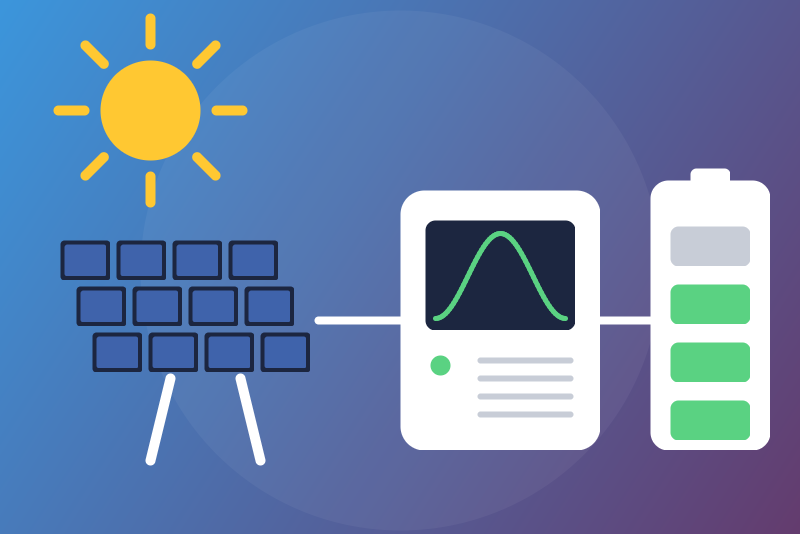
Unofficial: Autarco solar inverters and batteries: production, power, battery, read-only.
Veröffentlicht von LM1LC3N7
- Geräte
- Version 0.1.1
- Erfordert Gladys >=5.2.0
- ★ 0
Die Dokumentation dieser Integration wird von ihrem Autor geschrieben und ist bisher nur auf Englisch verfügbar.
Unofficial integration, not affiliated with Autarco. It reads the installations of your Autarco account (solar inverters, and batteries when there are some) through the public API of my.autarco.com, with the e-mail address and the password of the account. Internet is needed.
Never tested with a real device: the integration was written from the python-autarco library (the one Home Assistant uses) and its test answers, without an Autarco account at hand. Your feedback is welcome.
Read-only
The integration only reads (GET requests of the public API). It changes nothing on your installation nor in your account.
What you get
One device per installation (site) of the account, named after it:
- solar power (W) and the solar production index (the total production of the installation, in kWh), for the Gladys energy monitoring, with its 30-minute production computed by Gladys;
- production of the day and of the month (kWh, plain sensors, never counted);
- health of the installation (1 = OK, 0 = a problem reported by Autarco).
With a battery (the values appear only when Autarco gives them):
- state of charge (%);
- battery power and net charge power (W), as given by Autarco: their sign (charge or discharge) has not been confirmed on a real installation, so they are plain signed sensors, never split into charge and discharge;
- energy charged and discharged today and in total (kWh, plain sensors).
With a meter (shown by a grid value; without one, Autarco repeats the production as consumption, which is then left out): grid net import and export (W, signs as given), grid import and export totals (kWh), consumption (W, today, total). All plain sensors.
One device per inverter: power (W), total production (kWh, plain sensor), health, grid turned off (0/1). The power of an inverter whose last message is more than 2 hours old (by the clock of the service) is not sent.
No double count
Only the total solar production of each installation feeds the Gladys energy monitoring, as an index. The counters of the day and of the month, the grid import (the main meter of your home, Linky..., already counts it), the injection and the battery counters are plain sensors: they are never counted nor billed by Gladys, and the integration never sends a daily consumption. If another integration already sends the same solar production to Gladys, create only one of the two production indexes.
The API gives whole kWh: the index rises by steps of 1 kWh.
Requirements
- Gladys 5.2.0 or later, with Internet access.
- An Autarco account on my.autarco.com (the one of the Autarco app).
Configuration
- Install the integration from the Gladys store.
- E-mail address and Password of your Autarco account. The password is kept by Gladys in its database, never shown again, sent only to my.autarco.com (HTTPS, in the header of its requests), never logged.
- Reading interval: 300 s by default (the pace at which the portal refreshes), 120 to 3600 s. Each read is one request for the account, then three per installation.
- After the first read, create the devices from the Discover tab.
The Test the connection button reads the account once if the interval has passed; otherwise it shows the last read and when the next one can be.
Only the first 30 installations of the account are read (the first page of the API); the status says so when there are more.
Pace of the reads
Nothing reads the account faster than the interval: not the test button, not
the Discover tab, not a reconnection to Gladys, not a save of an unchanged
configuration, not a restart of the container (the time of the last read is
kept in /data, written at most once a minute and at a clean stop: after a
restart, the first read waits the interval plus a minute). New credentials
are tried at once.
Held index
Gladys counts every rise of an index in full. So that no fictive energy is ever counted, the solar production index of each installation goes through a guard:
- a value of 0 is never sent;
- a drop, or a rise faster than 50 kW on average (plus 1.5 kWh), is held back: the last accepted value is sent again, and the status of the integration shows it. Neither time nor repetition confirms it; a drop that comes back up is taken again as soon as it passes the last accepted value;
- if it is right, click Accept the held index twice: the first click lists what is held and accepts nothing, the second, 3 seconds to 5 minutes later, accepts exactly what was listed (a jump is then counted at once, a drop counts nothing). Saving the configuration accepts nothing.
Errors
- E-mail or password refused (HTTP 401 of the account): the reads
stop, the status says so, and no new try is ever made by itself
(this stop is kept in
/dataacross a restart). Check your credentials on my.autarco.com and save the corrected credentials: new credentials are tried at once. Saving unchanged credentials reads nothing; only the Test the connection button tries them again (once per click, at the pace of the reads), and only a success lifts the stop. To recognise the refused credentials after a restart,/datakeeps only an 8-bit marker of them (it can confirm no password), erased by the first successful read. - A password with accents or other non-ASCII characters: the integration sends it in UTF-8, while the library it comes from sends latin1; which one Autarco expects is not confirmed. If such a password is refused while it works on my.autarco.com, a password made of plain ASCII characters avoids the doubt (and please tell us).
- HTTP 429 (too many requests), anywhere: the reads pause, for the delay
asked by Autarco, else 1 minute doubled at each new one, but never shorter
than the reading interval (at 300 s: 5, 5, 5, 8, 16... minutes), up to
6 hours, kept in
/data. An HTTP 5xx or 403 of the account pauses the same way. - An error of one installation (5xx, an odd answer) only leaves its values out: the others are published. An installation that does not answer in time ends there, and the read goes on with the next ones; only Autarco out of reach, or two installations in a row without an answer, stop the rest of the read. The first installation read changes at each read, so that none is always left last. The status names the installations not read in full, and says whether the others are up to date.
- An installation that refuses access (401 or 403) while the account is accepted is left out, tried again later (the interval doubled, up to once an hour); the status lists it.
- The solar power of an installation is not sent when all its inverters with a known time have been silent for more than 2 hours (by the clock of the service): it is not a current value.
- Autarco unreachable: new try after the interval, doubled up to 30 minutes.
Privacy
The integration talks only to my.autarco.com, over HTTPS, and follows no
redirect: your credentials never go elsewhere. Neither the e-mail address nor
the password is ever written to the logs, to the status or to /data (the
account is kept there as a salted fingerprint only). The names of the
installations are kept in memory only.
Konfigurationseinstellungen
Diese Einstellungen fragt Autarco in seinem Konfigurationsbildschirm in Gladys ab.
| Einstellung | Typ | Pflichtfeld | Beschreibung |
|---|---|---|---|
| Autarco | section | Nein | Unofficial connector, not affiliated with Autarco. It reads the installations of your Autarco account through the public API of my.autarco.com (Internet needed), every 5 minutes by default: solar power, production of the day, of the month and in total, each inverter, and with a battery or a meter its state of charge, powers and counters. The total production of each installation becomes its solar production index for the Gladys energy monitoring. Read-only: it never changes anything on your installation. Never tested with a real device. |
| E-mail address | string | Ja | The e-mail address you sign in with on my.autarco.com. |
| Password | secret | Ja | The password of your Autarco account. Kept by Gladys in its database, never shown again; sent only to my.autarco.com (HTTPS), in the header of its read requests, never logged. |
| Reading interval (s) | number | Nein | How often the account is read (one request, then three per installation): 300 s by default, the pace at which the portal itself refreshes. Nothing reads it faster, not even the test button, except new credentials, tried at once. |
So installierst du Autarco in Gladys
- Öffne in Gladys Integrationen: Autarco erscheint im Katalog neben den nativen Integrationen, mit einem Community-Badge.
- Klicke auf Installieren. Gladys lädt das Docker-Image (
ghcr.io/lm1lc3n7/gladys-autarco:0.1.1) herunter, startet es in einer vom Kern isolierten Sandbox und erzeugt die Oberfläche der Integration (Geräte, Erkennung und Konfiguration). - Öffne den Bildschirm Konfiguration der Integration, fülle die Einstellungen aus und speichere.
- Du kannst sie auch direkt über die URL ihres Repositorys installieren: https://github.com/LM1LC3N7/gladys-autarco.
Autarco benötigt Gladys >=5.2.0. Der Katalog in Gladys wird stündlich aktualisiert, eine neue Version ist also spätestens eine Stunde nach ihrer Veröffentlichung verfügbar.
Du nutzt Gladys noch nicht? Es ist kostenlos und Open Source: folge der Installationsanleitung, um loszulegen.
Über externe Integrationen
Autarco ist eine externe Integration: eine Community-Integration, die als Docker-Container verpackt und auf GitHub veröffentlicht wird. Gladys installiert sie mit einem Klick und führt sie in einer vom Kern isolierten Sandbox aus. Sie wird von LM1LC3N7 veröffentlicht und gepflegt, nicht vom Gladys-Kernteam.
- Alle Integrationen durchsuchen, native und aus der Community
- Deine eigene externe Integration bauen und veröffentlichen
- Quellcode auf GitHub — Quelle dieser Dokumentation