Balcony solar in Germany: the rules, and how to get the most out of it
A Balkonkraftwerk only saves money on the electricity you use yourself: what you feed into the grid isn't paid. Here are the 2026 rules, and how to shift your consumption to sunny hours, automatically.
Plug-in solar devices (Balkonkraftwerke or Steckersolargeräte) have become very simple in Germany: since 2024, up to 800 W of inverter output and 2,000 W of modules, a single registration in the Marktstammdatenregister, and no VAT on the hardware.
The catch: surplus electricity fed into the grid isn't paid. Without a battery, a typical household uses a bit more than half of its balcony solar power (57% in an ADAC simulation with HTW Berlin's tool). Every kWh you move to the sunny hours is a kWh you no longer buy at full price.
The rules in 2026
What applies to plug-in solar in Germany:
- Up to 800 VA of inverter output per meter and up to 2,000 W of module power (Solarpaket I, since May 2024).
- You only register it in the Marktstammdatenregister: no separate notification to the grid operator. An old meter may run backwards until it's replaced.
- Since December 2025, the VDE product standard allows the normal Schuko plug up to 960 W of modules. Above that, up to 2,000 W, you need a special energy socket.
- Tenants and apartment owners have a right to install one since October 2024. A landlord can only refuse if it's unreasonable, not for looks alone.
- No VAT on modules, inverters and storage. Surplus fed into the grid isn't paid, and balcony systems are exempt from the Solarspitzengesetz feed-in limits.
With a battery, the 800 VA limit still applies to what goes into your home's grid, and the rules for storage were still evolving in 2026: check the manufacturer's notes and the Verbraucherzentrale.
What a balcony system yields
Figures for a 2,000 Wp / 800 W system facing south without shade, in a 4,000 kWh household (ADAC, September 2026, HTW Berlin simulator):
| Without battery | With a 2.5 kWh battery | |
|---|---|---|
| Yearly production | About 1,560 kWh | About 1,560 kWh |
| Used at home | 57% | 87% |
| Savings per year (35 ct/kWh) | About €335 | About €509 |
A vertical mount on a balcony railing produces much less. And every kWh you use instead of feeding it in raises the savings, battery or not: that's where automation helps.
Use more of your own solar power
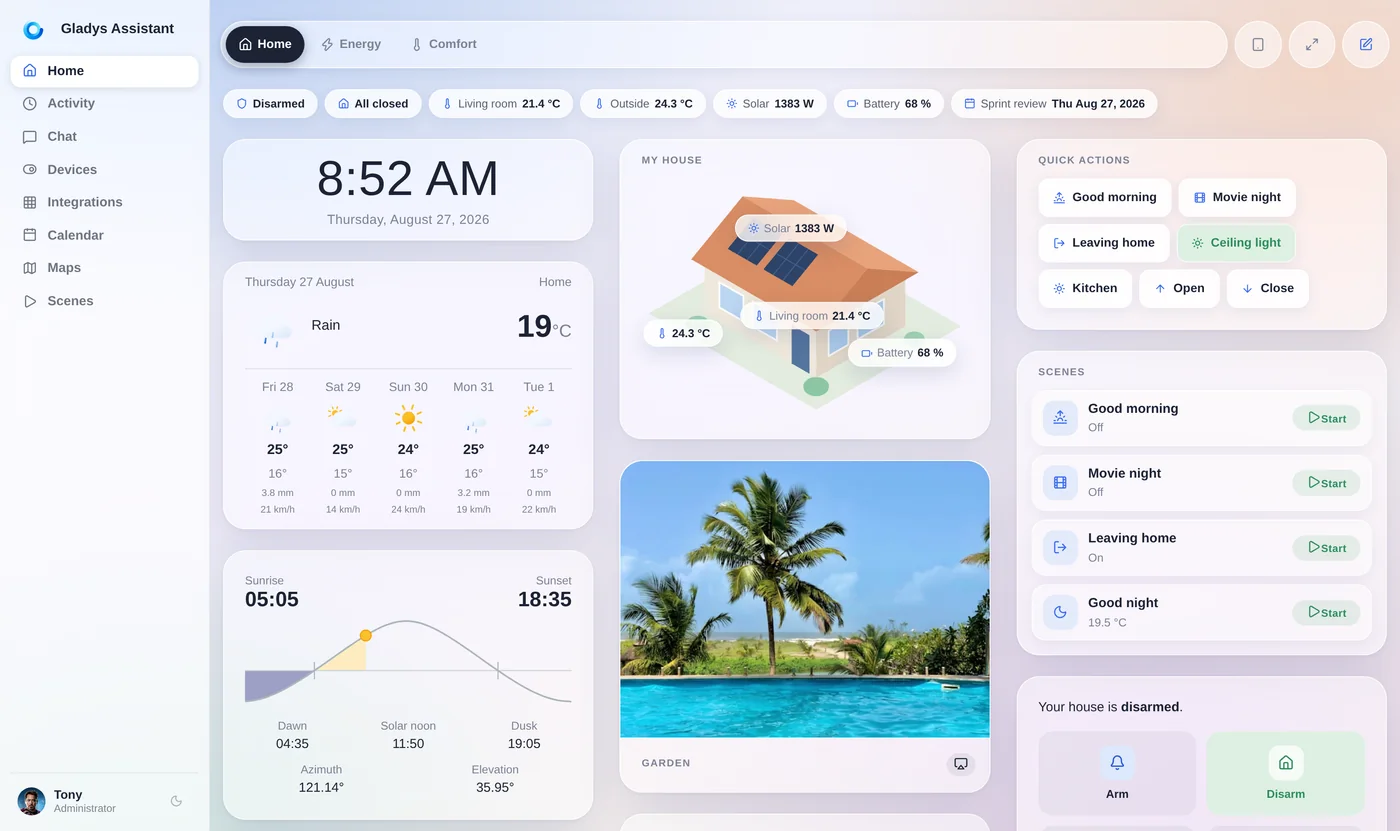
With Gladys, your appliances follow the sun:
Hoymiles through OpenDTU, APsystems EZ1, Anker SOLIX or Zendure: your balcony production live and in your energy history.
A Shelly energy meter measures what your home takes from and returns to the grid, so a scene knows when there's surplus.
Start the dishwasher or the washing machine on a smart plug when production is high, instead of in the evening.
A free solar forecast tells you how much you'll produce today and tomorrow, and triggers a scene when the estimated power crosses a threshold.
With an Anker SOLIX Solarbank 2 or 3, Gladys can change the usage mode and the output power to your home.
With OpenDTU, a scene can change your Hoymiles inverter's power limit, in watts or percent.
Getting started
In a few steps:
- Register your system in the Marktstammdatenregister once it's running.
- Connect your inverter or battery to Gladys (OpenDTU, APsystems, Anker SOLIX, Zendure…) to see your production.
- Add a meter that sees your grid exchange (for example a Shelly Pro 3EM), so Gladys knows when you have surplus.
- Put your flexible appliances on smart plugs, and create a scene that starts them when production is high.
- Add a solar forecast to plan the day: wash today or tomorrow?
Gladys is free and open source, and runs on your own hardware.
Why automate it
A balcony system produces most around midday, when many households are out. Without a battery, that power goes to the grid for free. Automation shifts what can wait (dishwasher, washing machine, water heater, charging) to those hours without you thinking about it.
Gladys Assistant runs these scenes locally, on a mini-PC or a Raspberry Pi at home. Most solar integrations talk to your devices on your local network, without a cloud.
Go further
More energy guides:
Combine your solar power with cheap exchange-price hours.
When the balcony isn't enough: surplus charging with a rooftop system.
Track your consumption and act on the data.
Every guide, tool and comparison in one place.
Frequently asked questions
How much power can a balcony system have in Germany?
Up to 800 VA of inverter output per meter and up to 2,000 W of module power, since Solarpaket I came into force in May 2024.
Can I use a normal Schuko plug?
Yes, up to 960 W of module power, according to the VDE product standard in force since December 2025. Between 961 and 2,000 W, you need a special energy socket (Wieland type).
Can my landlord refuse a balcony system?
Since October 2024, tenants have a legal claim to install one (§554 BGB). The landlord can only refuse if it's unreasonable after weighing both sides' interests, not just for looks. Apartment owners can demand it too; the owners' community only decides how it's installed.
Do I get paid for the electricity I feed in?
Usually not: surplus from a balcony system is taken by the grid without payment. That's why using as much as possible yourself, with automation or a battery, is what makes it pay off.
Do I need to register it?
Yes, in the Marktstammdatenregister of the Bundesnetzagentur. Since 2024, a separate notification to the grid operator is no longer required.
Get more out of your balcony solar
Gladys is free, open source and installs on a mini-PC from a USB drive. See your production and run your appliances when the sun is out.